FPL Player List: Positions, Filters and Player Profiles

You've got the FPL player list open in one tab, the deadline clock in another and £1.7m in the bank. Sorted by total points, the first name on the screen has started four of eleven matches. That's the point where a directory stops being a directory and becomes a decision.
If his minutes are secure and his role is unchanged, the sort has done its job and you can move on.
If his starts hinge on a Friday press conference, or his position changed in pre-season, the same name belongs in a monitor column, not a buy column.
The list is a decision dataset built from position, price, minutes and availability, and those four rarely move together. Players arrive after launch. Positions get reclassified. Prices shift daily, and the market fields refresh on a different cycle from completed-match points.
Build the shortlist so each of those four gets checked on its own.
Positions, Squad Slots and Scoring Rules
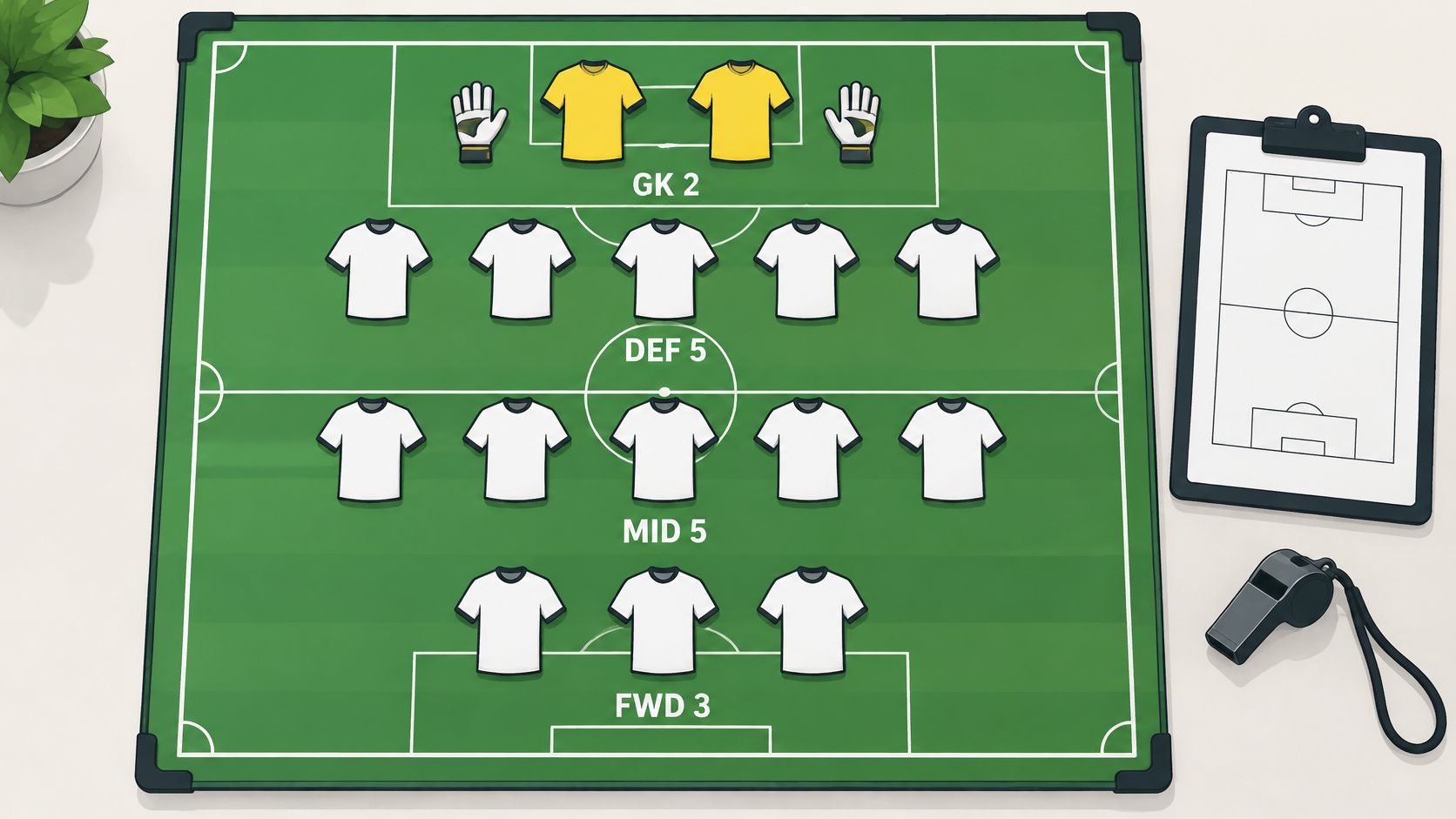
The squad sheet comes before any filter. The official FPL rules set both the shape and the scoring: a 15-player squad of 2 goalkeepers, 5 defenders, 5 midfielders and 3 forwards, 2 points for playing at least 60 minutes, 3 points for an assist, and goals worth 10, 6, 5 and 4 for a goalkeeper, defender, midfielder and forward respectively.
Eleven of those fifteen score each Gameweek and four sit on the bench in a fixed order, so the sheet needs a slot column as well as a position column.
Two players competing for the same slot aren't interchangeable, because the route to points diverges by position before a ball is kicked. A tactics board makes that constraint visible.
Scoring gets more positional still. Clean sheets pay 4 points to goalkeepers and defenders but only 1 to a midfielder, and a defensive contribution adds 2 points once a defender reaches 10 qualifying clearances, blocks, interceptions and tackles or a midfielder or forward reaches 12 actions, as the Premier League's scoring guidance explains.
Scoring category | Goalkeeper | Defender | Midfielder | Forward |
|---|---|---|---|---|
Playing at least 60 minutes | 2 | 2 | 2 | 2 |
Assist | 3 | 3 | 3 | 3 |
Goal | 10 | 6 | 5 | 4 |
Clean sheet | 4 | 4 | 1 | 0 |
Defensive bonus threshold (2 points) | Not applicable | 10 qualifying actions | 12 qualifying actions | 12 qualifying actions |
The practical consequence is that a centre-back with reliable 90-minute starts can be the better final starter than a rotation-prone midfielder who needs a goal.
Prices are a separate market. They stay fixed before the season starts, then move with transfer-market popularity, and when a player rises in value a manager keeps only half of the increase on sale, rounded down to the nearest £0.1 million.
That resale rule kills one common instinct: buying a player because his price is climbing recovers less of the rise than the ticker suggests.
Build the sheet this way: position, slot type, price band, the position-specific points route, minutes and availability. Sort by the first three, then judge the last three.
Group by position first, then by price band inside it, so you're comparing like with like. If you're weighing how a real team's shape changes which players collect defensive actions, a tactical explainer for United fans is worth reading before you set the slot column.
Rank the bench by likelihood of playing rather than by reputation or price. A cheap defender who starts every week outscores an expensive squad player who gets fifteen minutes.
Stating the Season, Gameweek and Capture Window
Every figure in this guide needs four labels: season, target Gameweek, capture date and statistical window. A number without them is a memory, not evidence.
This guide is written for the 2026/27 season with a current date of 13 November 2026. The target Gameweek and the capture time of the official feed aren't fixed here. Read them off the live export and write them at the top of the sheet before you compare two players.
Live totals drift within hours. Official gameweek records for 2026/27 show more than 11.28 million registered teams, with one entry page reporting 11,281,606 total players and another 11,282,229 (official FPL gameweek record). Two pages, two figures, one season. The capture time is what makes either usable.
Market fields and completed-match statistics refresh on separate cycles, so each carries its own timestamp on the sheet.
Label every column: season, target Gameweek, capture date, statistical window. Unlabelled figures don't get to inform a transfer.
Reading the Data Behind Every Player Record
The official bootstrap-static feed is a reference layer before it's a ranking table. It holds player records, clubs, gameweeks, positions, the scoring configuration and the game settings that define the season (FPL bootstrap-static feed).
Each player record carries identifiers, a display name, club and position references, points, minutes, ownership, form, availability status and expected goal and assist fields.
Those fields answer different questions, and mixing them is where shortlists go wrong.
Minutes tell you whether the player has a role at all.
Form is a recent-window summary, not a statement about the fixture ahead.
Ownership describes what other managers have done, not the merit of the pick.
Availability status flags doubt without quantifying it, so it needs the news page beside it.
Joining identifiers to dictionaries
Player and club numbers are joins, not labels. A player's club reference has to be read through the team dictionary and his position reference through the position dictionary, or the numbers mean nothing at all.
Two errors account for most broken sheets. Treating a player ID as a club ID drops a forward into the wrong team's fixture run. Reading a current-Gameweek value as a season aggregate overstates a player who has just had one good afternoon.
Price needs the same discipline. Values are stored in tenths of a million pounds, so an integer of 158 is £15.8m. Convert before you sort or budget, not after.
The structure supports practical filters once the joins are right: by position, price, minutes, club, status and role.
Data quality comes from how the snapshot is stored. Keep the season, the retrieval timestamp and the Gameweek context with every export, and preserve raw values beside the normalised fields so a mis-mapping can be reversed rather than guessed at.
Completed-match statistics belong in their own version, separate from market fields and next-Gameweek fields, because the official game updates points as matches finish while prices can change daily once the season begins. Player prices, points, ownership, form, transfers and expected statistics all come from the official Fantasy Premier League data.
Snapshot check: before comparing two players, confirm the export states its season, its Gameweek and the time it was captured. If any of the three is missing, rebuild it.
Filtering the Player List by Position, Club and Price
A long list isn't a shortlist. Filters do the narrowing, and the order matters because each step removes names that can't answer the question you're asking.
Position first. A goalkeeper and a midfielder answer different squad questions, so filtering by position stops you comparing a clean-sheet asset with a goal asset.
Availability second. Isolate the flagged players so the dependable names sit at the top and the doubtful ones sit in a separate column.
Minutes third. Apply a threshold, and keep season minutes and recent-window minutes in separate columns rather than averaging them into one figure.
Club fourth. Cap how many players you hold from the same side, so one bad fixture doesn't hit three of your starters at once.
Price band last. Four bands do most of the work: under £5.0m, £5.0m to £6.0m, £6.0m to £8.0m, and £8.0m and above.
Order beats sophistication. A manager who runs five filters in the right sequence gets a better shortlist than one who applies a custom score to an unordered set of names.
Two defenders at the same price can differ by an hour of expected football each week, and the price column will never show it.
Sorting by price or total points alone hides the players who barely play. A points total built on a handful of substitute appearances is a different asset from the same total built on weekly starts, even though the list treats them as equals.
Position, price, minutes and availability filters remove players who don't fit a squad decision, and that removal is the useful part. A filter is a starting point, not a verdict.
Four checks to reuse each Gameweek: position, availability plus minutes, club concentration, price band. If a name survives all four, it earns a place on the shortlist.
Tracking Players Added and Reclassified After Launch
The list you exported in August is not the list you're choosing from in November.
In the 2025/26 game the Premier League added players after launch, including Viktor Gyökeres at £9.0m, Hugo Ekitike at £8.5m, Benjamin Šeško at £7.5m and several £5.0m to £6.0m options (Premier League note on new additions).
A list sorted only by current price or total points goes incomplete the moment a transfer window closes, because the newest names sit near the bottom with almost no points attached to them.
Position changes do more damage than new entries. The same 2025/26 record shows Myles Lewis-Skelly moving from defender to midfielder, and Cody Gakpo and Matheus Cunha moving from midfielder to forward.
A reclassification changes the scoring path, the squad slot and the comparison set in one move. Any shortlist built before the change is measuring a player who no longer exists in that form.
Four fields for a changelog
Record the date, the player, the previous and current position or price, and any club transfer. Review it at the start of each Gameweek so the sheet reflects the game rather than your memory of it.
During an open window, run the changelog more often than the shortlist. A name added on deadline day and a name reclassified in pre-season both alter the budget structure you're working inside.
The temptation with a late addition is to read his first two appearances as form. It isn't. A small points sample from a new signing says he has played, not that his role is settled or that his price is fair.
Check the official rules and announcements for how and when players enter the game rather than assuming a fixed schedule, because the timing follows registration and processing rather than your planning cycle.
Everything above describes the 2025/26 game and works as an example of how the list moves. Re-check any entry, price and position change against official FPL data and official club reporting before treating it as current.
Availability and Minutes Before Starting a Player
A green flag beside a name means the game hasn't ruled the player out. It doesn't mean he starts.
The official player news resource records injury descriptions, expected return dates and a percentage chance of playing for each flagged player, which makes availability a probability rather than a yes or no (official player news).
The Premier League's 2025/26 pricing analysis put the same problem in numbers: Micky van de Ven was limited to 12 starts through injury in the previous campaign while remaining a relevant defensive asset.
Two defenders can carry the same price and the same position while one plays thirty-five times and the other twelve.
The bench makes minutes a hard requirement
Minutes decide selection before points do. When a selected starter doesn't feature, FPL replaces him with the first eligible substitute, then the second, then the third.
A ten-minute cameo from a doubtful starter counts as featuring, so he blocks the bench player who would have scored in his place. That one-point appearance costs you the clean sheet sitting behind him.
That's why a cheaper player with secure minutes can be the better pick for bench planning and for multi-Gameweek transfer decisions than a higher scorer whose starts are uncertain.
Attach a confidence label to each shortlist entry. Secure means he starts when fit and his role is unchanged. Conditional means the start depends on team news. Avoid means the minutes aren't there this week whatever the price.
Check the official player news for every shortlisted player before the deadline: injury, suspension, expected return and the percentage chance attached to each. Start rate, substitute appearances and minutes per appearance sit beside the official news in our minutes research tool.
A chance-of-playing flag starts the question. The role, the minutes and the fixture answer it.
Reading Chance Statistics Without Overreading Them
Expected goals and expected assists measure the chances a player was involved in during a defined window. They are evidence of involvement, not a forecast of the next return.
Derived xGI per 90 combines the two into a rate, which is the right tool for comparing players with different minutes and the wrong tool for a player whose minutes are unstable. Compare that rate with the same player's actual returns over the same window and you learn whether his output is running ahead of the process or behind it.
Three ways a chance figure misleads
A small sample. Four appearances, two of them from the bench, produce a per-90 rate that flatters almost anyone.
A mixed window. Season totals and recent-form samples answer different questions and never share an unlabelled column.
A forecast label. Official expected points covers the next Gameweek only. It isn't a four-week projection and shouldn't be displayed as one.
TFA projections are estimates rather than official FPL forecasts, and each one is labelled with its method explained beside the map.
Say a forward posts a strong xG figure across four appearances, two of them as a substitute. The chance involvement is real evidence that he's getting into scoring positions. The minutes say the role isn't proven, and a per-90 rate will keep flattering him until he starts regularly.
Record the statistical window and the capture date beside every chance figure, so a strong number from September isn't quoted as this week's evidence.
Season and recent-form context for each player sits in our attacking stats, which is the place to check a window before you quote it.
Deciding Whether to Buy, Hold or Sell
Two managers can look at the same name and reach opposite conclusions, because buying a player and holding one you already own are different decisions with different costs.
A buyer has to justify the move against the alternatives in the same price band. An owner only has to justify keeping what he already has, which is a lower bar.
Holding is defensible when the role is secure and the difficult fixture is one match away. Selling costs more than it looks, because an extra transfer to fund the move can mean a four-point hit, so the sale needs a stronger reason than the purchase did.

The official FPL help pages frame the season as 38 Gameweeks with a 15-player squad, and treat transfers as the tool for reacting to injuries, fixtures, form and changing squad value.
That supports a rolling plan. Judge the next fixture for immediate selection, then look at the schedule behind it before committing a transfer or taking a hit. A strong short-term fixture doesn't justify buying a player whose minutes are uncertain or whose role has just changed.
Budget belongs in the verdict. A cheaper replacement can fund a second upgrade, while an expensive purchase removes the flexibility to fix the next problem.
A worked verdict
Say you're weighing a £6.0m midfielder with a secure starting role against a £5.5m alternative whose minutes are uncertain.
As an owner of the first player, holding is defensible while the role holds, because the saving from selling is smaller than the risk of losing a starter.
As a buyer with spare budget, the second player is a monitor until his role is confirmed, not a buy at a discount.
That's the discipline a list is for. It gives you the price and the position. You supply the minutes, the role and the timing.
Four labels, four conditions: buy when role and minutes are secure and the fixtures support it, hold when the role holds and the next bad fixture is isolated, sell when the role or the minutes have gone and a hit is still worth taking, monitor when team news lands before the deadline.
Each label is conditional on minutes and availability, and each carries the season, the Gameweek window and the verification date it was set from. Our value picks work through the same comparison band by band.
Confirm the Shortlist Before the Deadline
Nothing on the sheet counts until it's checked against the live game.
Price and position: confirm both in official data, because a reclassification or a market move can land between the export and the deadline.
Club and availability: check the club, the injury or suspension status and the percentage chance of playing.
Minutes: confirm the recent start pattern rather than the season average.
Club reporting: read official club reporting for a role change or an injury the game data hasn't caught up with.
Labels: copy the season, the target Gameweek and the capture date onto the sheet, then rerun the check when the market or live data refreshes.
The FPL Player Stats homepage is the entry point for the player directory and the shortlist maps. Differential Picks, Budget Picks and Form Plus Next Fixture are free, as is every individual player profile, while the other 14 maps and nine FPL tools are available to paid TFA members. Player Stats covers 669 players, with in-depth stats and match histories.
Once the shortlist passes, return to the verdict and act only if its conditions still hold. A name that fails a check at ten in the morning isn't rescued by a good price.
Before the deadline, open the player directory, run the five checks against your current squad and your one transfer target, and write the season, the target Gameweek and the capture date at the top of the sheet. Then decide. A shortlist that survives the checks deserves the move. One that doesn't was never a shortlist.