Best Goalkeepers In The Premier League: FPL Gameweek 10 Buy Or Hold?
Raya, Verbruggen, Kinský and Tzolakis offer different FPL decisions before Gameweek 10. Compare the prices, defensive evidence, fixture runs and cost of changing goalkeeper.
David Raya leads the goalkeeper points table, but that does not make him the automatic transfer for every FPL team. Bart Verbruggen is only three points behind and costs £1.6m less. For an existing Raya owner, that is a reason to examine the budget, not necessarily a reason to sell.
The best goalkeepers in the Premier League for FPL depend on what your squad needs. A manager fixing a non-starter needs reliable minutes. A manager on a Wildcard can compare the whole goalkeeper pairing. An owner with a dependable starter needs a convincing improvement before spending another transfer in goal.
My starting point before Gameweek 10 is to hold Raya if the rest of the squad works, consider Verbruggen for a cheaper new purchase, and assess Antonín Kinský when the budget is tighter. Konstantinos Tzolakis illustrates why a productive goalkeeper can be a reasonable hold without being the player I would buy this week.
Research checked on 3 November 2026 for 2026/27. Statistics include the nine league matches played by these goalkeepers through Gameweek 9. Those fixtures were marked finished in the official feed, but Gameweek 9 itself had not been finalised, so its points remain provisional. Prices, availability and fixtures are a dated snapshot; recheck before the Gameweek 10 deadline of 6 November, 18:30 UTC.
Four Goalkeepers, Four Different Decisions
All four have played 810 league minutes and started nine times. That makes the comparison cleaner than ranking a part-time starter against someone who has played every match. None had an availability warning in the official FPL snapshot, although that cannot guarantee the next selection.
Goalkeeper | Price | Points | Clean sheets | xGC |
|---|---|---|---|---|
£6.2m | 54 | 6 | 7.23 | |
£4.6m | 51 | 6 | 13.00 | |
£4.4m | 38 | 4 | 9.96 | |
£4.7m | 43 | 3 | 13.26 |
Source: the official FPL player dataset, checked against individual match histories. xGC means expected goals conceded while the goalkeeper was on the pitch. These are selected options with different budget and fixture cases, not the top four in points order.
Raya: A Strong Hold, With A Premium To Justify
Raya's six clean sheets are supported by the lowest xGC in this comparison. Arsenal have allowed 7.23 expected goals across his nine full matches, against Brighton's 13.00. Equal clean-sheet totals have therefore come from different levels of chance exposure.
That is a reason to value Arsenal's defence, but it is not a forecast of six clean sheets in the next nine matches. The opponents and defensive personnel still matter.
Hull City at home in Gameweek 10 gives existing owners little reason to rush into a change. The following run includes Newcastle away and Manchester City at home, so a new buyer should assess the whole period rather than treating the Hull fixture as the investment case.
I would hold Raya if his price is not preventing an important improvement elsewhere. For a new purchase, the question is whether his expected advantage is worth the £1.6m extra over Verbruggen and an Arsenal squad slot. If that money repairs a weak outfield starter, the cheaper goalkeeper can produce the better team.
Verbruggen: The Value Case Needs A Defensive Caveat
Verbruggen's 51 points at £4.6m make him the cheaper option I would examine first here. His next four opponents are Brentford at home, Hull away, Newcastle at home and Bournemouth away. There is no need to buy him solely because his latest match produced 11 points.
Brighton have conceded seven actual goals against 13.00 xGC in his minutes. That gap can reflect goalkeeping, opponents' finishing and the way chances were distributed. It does not establish that Brighton can keep matching Arsenal's clean sheets.
The appeal is the combination of price, nine full matches and a usable fixture run. Buy with room for some clean-sheet regression in the plan. If you already own him, a subsequent blank would not by itself undo that case.
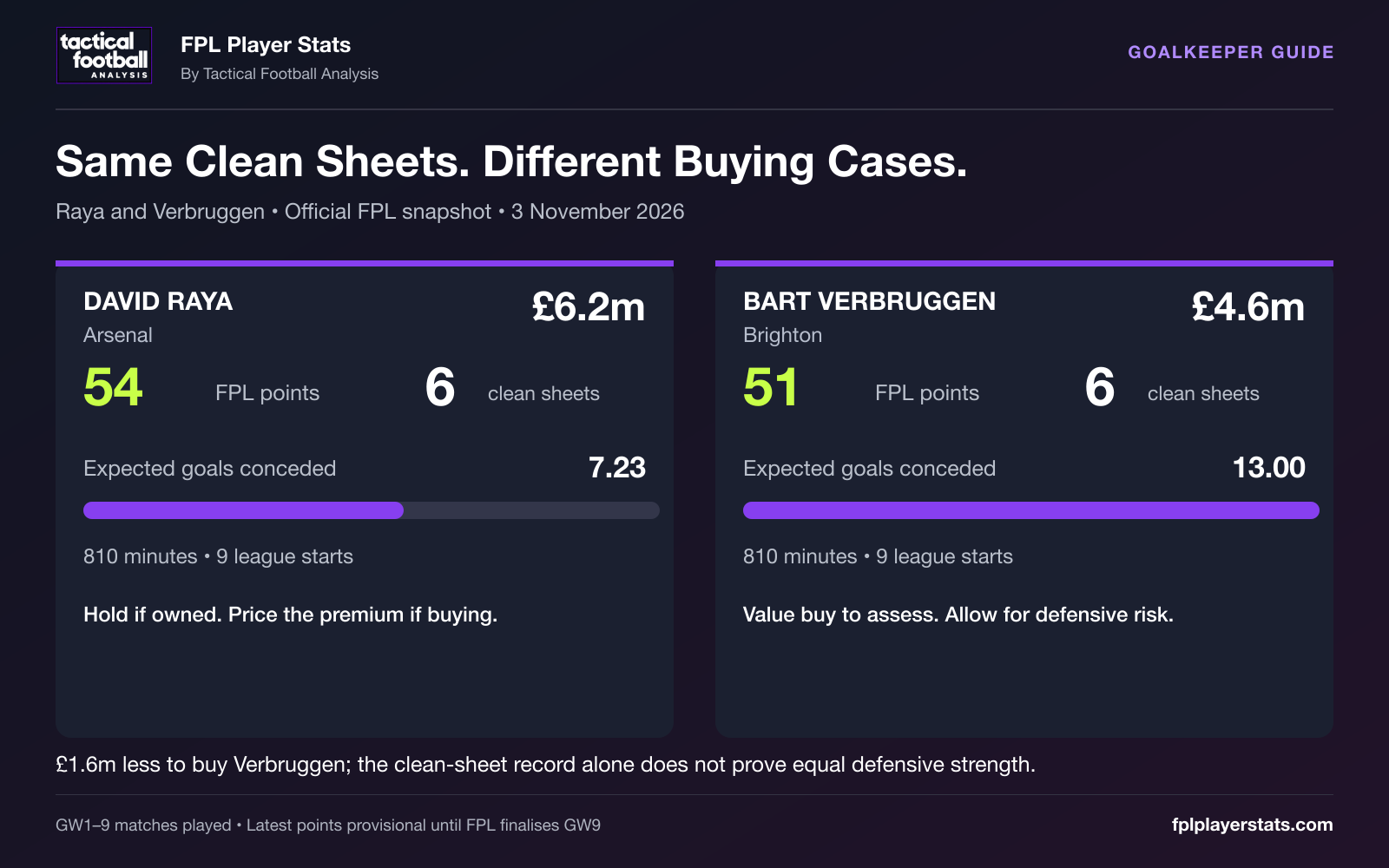
Equal clean-sheet totals do not mean equal defensive protection. Prices and match statistics captured on 3 November 2026; the latest points remain provisional.
Kinský: A Budget Route With A Useful Four-Match Window
Kinský costs £0.2m less than Verbruggen and £1.8m less than Raya. Leeds away, Ipswich at home, Sunderland away and Fulham at home form the next four fixtures, before Arsenal visit Spurs in Gameweek 14.
Four clean sheets and 9.96 xGC across nine full matches give the price case some substance. I would include him in a budget shortlist, especially where the saving completes another upgrade, while checking that the league role remains secure.
Owners of another sound budget starter do not need to spend a transfer merely to save £0.2m. That small saving matters when you have a specific use for it; otherwise it can be an expensive way to tidy the squad.
Tzolakis: A Hold Can Be More Sensible Than A Buy
Tzolakis has 32 saves and 43 points, but his three clean sheets all came in the opening three gameweeks. The six matches since then have produced none. A season total alone hides that change in the pattern of returns.
Hull visit Arsenal next, then host Brighton. I would prefer the other budget routes for a fresh purchase before Gameweek 10, subject to the rest of the squad and late team news.
For an owner, the calculation is less urgent. Tzolakis is still playing every league minute, and a difficult fixture can bring save points. Holding him while repairing an injured outfield player can be the better use of a transfer. If the squad has no other problems, comparing his next four matches with Kinský's is reasonable; taking a hit just to escape Arsenal needs a much larger expected gain.
Read The Fixture Run Before Paying For A Change
Use the fixture research page to compare the same ownership period for every candidate. Four gameweeks is the working window here, not a rule that every goalkeeper must be sold after four matches. Extend it when you expect to keep the player for longer.
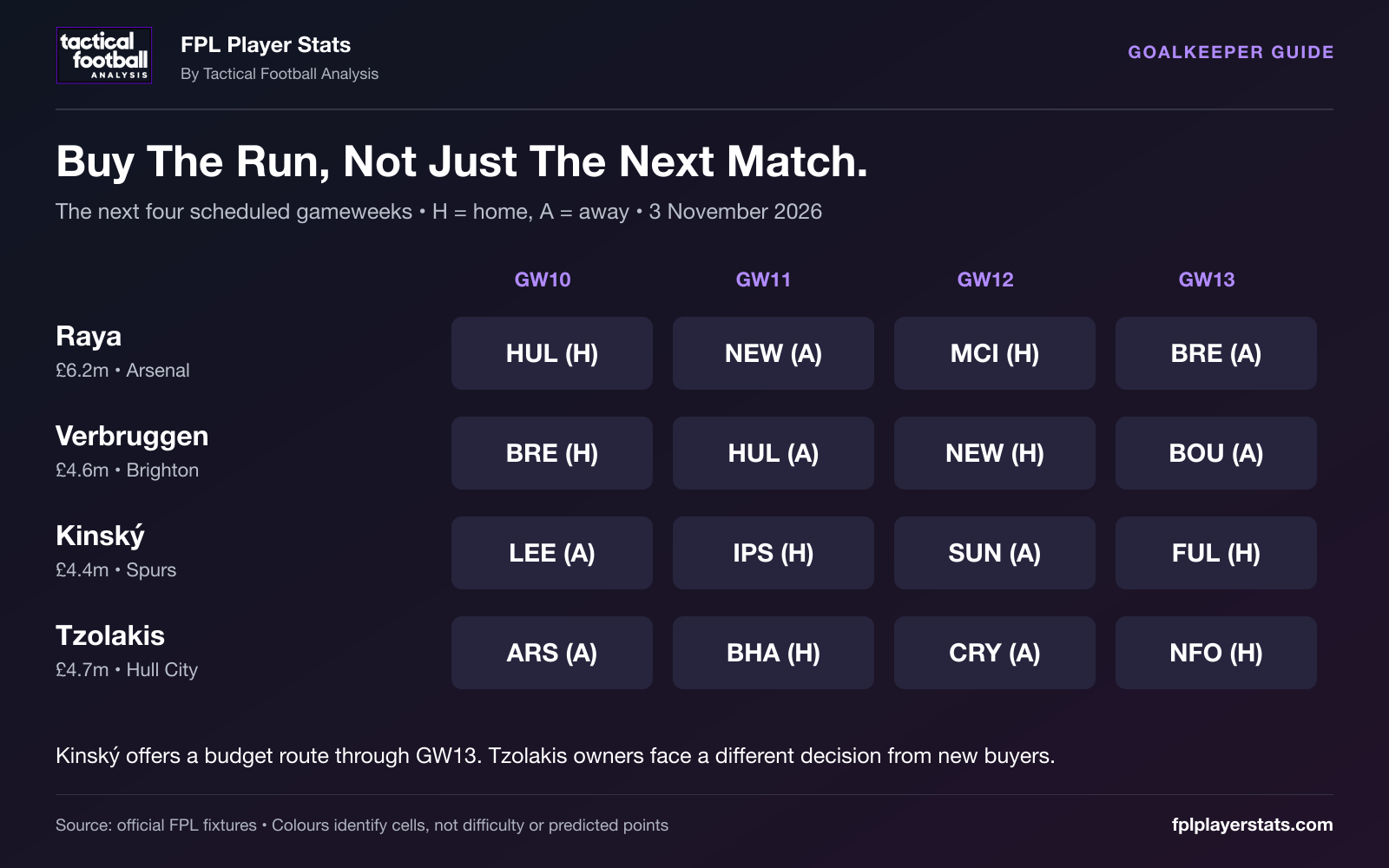
Scheduled Gameweeks 10 to 13, checked against official FPL fixtures on 3 November 2026. The purple cells identify fixtures; they are not difficulty ratings or points forecasts.
A favourable attacking fixture need not be equally attractive for a clean sheet. Consider how much threat the opponent creates, whether the match is home or away, and whether the defence is missing important players. Fixture colours help organise that work; they cannot complete it.
Keep starting decisions separate from transfers. If you already own two playing goalkeepers, choosing between them costs no transfer. Buying a second one to manufacture the same weekly choice ties up more budget and may not improve the rest of the squad.
Count The Points, Not Just The Saves
The official FPL rules award a goalkeeper two appearance points at 60 minutes, four for a qualifying clean sheet and one for each three saves in a match. Every two goals conceded cost one point. A penalty save adds five, while cards and other deductions can reduce the total.
Consider two simple examples, each with 90 minutes and no bonus, cards or penalty incidents:
A goalkeeper with a clean sheet and one save scores six points: two for appearing and four for the clean sheet.
A goalkeeper with six saves and two goals conceded scores three points: two for appearing, two for saves and minus one for the goals conceded.
The busy goalkeeper still has a route to points, but workload is not automatically an advantage. Twelve saves supply four save points; they do not guarantee that the total will beat a clean sheet after goals conceded and bonus are included.
Crucially, calculate save points match by match. Raya's 18 saves in the current sample produce only three save points, not six. Several matches ended with one or two saves, and those unused saves do not carry forward.
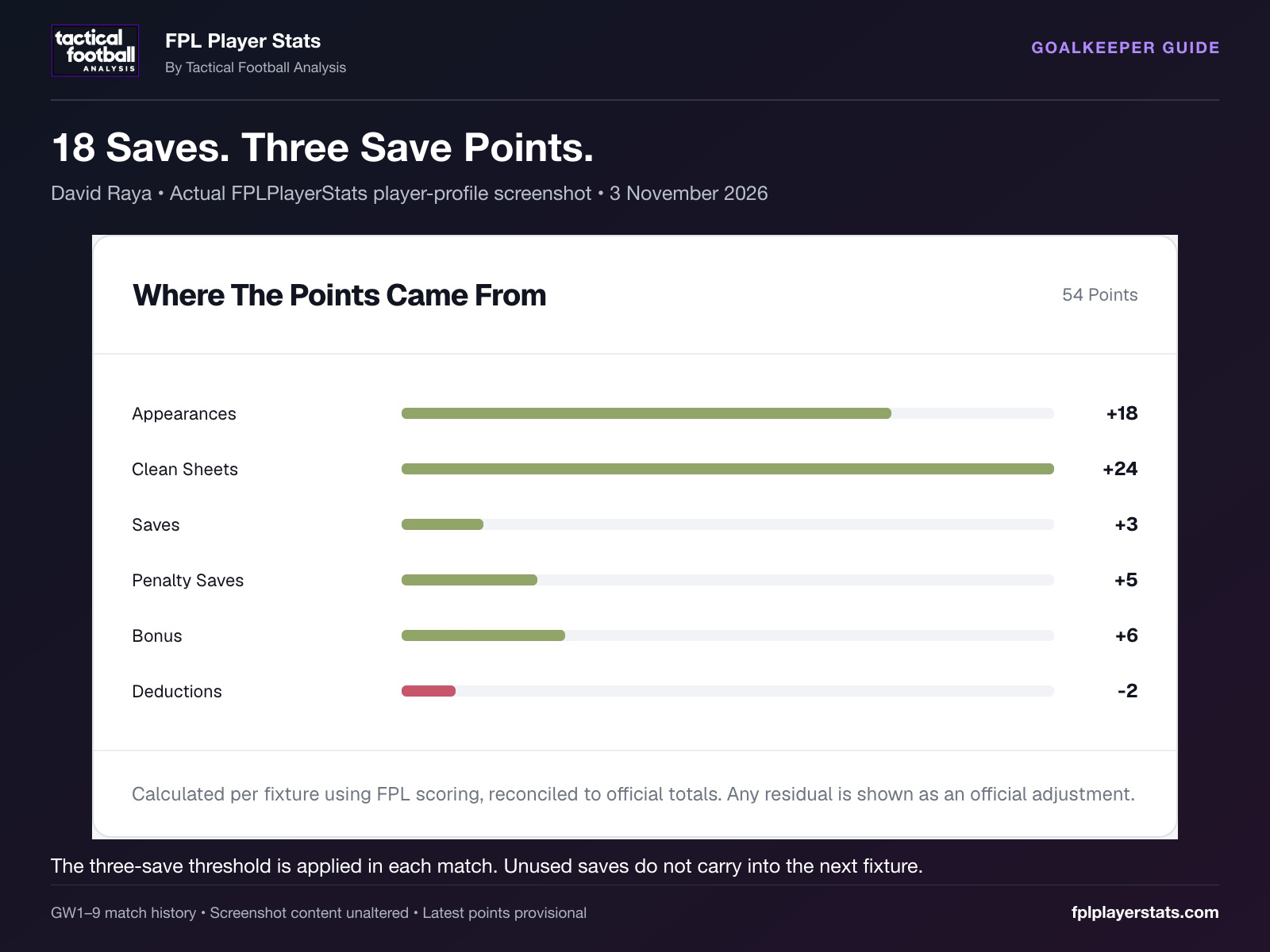
Raya's actual FPLPlayerStats points breakdown, captured on 3 November 2026. The screenshot is unaltered inside the branded frame. Match totals cover Gameweeks 1 to 9 and are provisional until FPL finalises the gameweek.
Our goalkeeper statistics page helps explore saves and total points; the Goalkeeper Stats tool separates the scoring routes. A high saves total should lead you to the match record, not straight to the transfer button.
The same caution applies to historical rankings. André Onana led the league with 149 saves in 2023/24, as the Premier League reported in May 2024. That is a record of work faced over that season, not a current recommendation or evidence that every save-heavy goalkeeper offers better value.
Use xGC And Bonus For The Questions They Can Answer
Expected goals conceded describes the quality of chances allowed before the shots are finished. It helps assess defensive exposure, but subtracting actual goals from xGC does not isolate a goalkeeper's shot-stopping ability.
Post-shot models add information about the execution of on-target shots. As StatsBomb's explanation of post-shot expected goals sets out, comparing that measure with goals conceded is more useful for judging saves above expectation. FPL's xGC is not the same statistic. Neither a small sample nor a model gap guarantees what happens next.
Bonus needs similar care. The official FPL help pages explain the BPS ranking within each match. A goalkeeper's BPS score is not itself the number of bonus points he receives, and a repeatable action still has to compete with everyone else's performance.
The 2026/27 BPS changes award two BPS for any save, another one for a shot saved from inside the box and another one for saving a big chance. These are BPS components, not extra FPL save points added directly to your team score. Both well-protected and busy goalkeepers can earn bonus; neither profile guarantees it.
Raya's penalty save accounts for five of his points in the screenshot. Keep that return in the record, but do not budget for another penalty save every few matches. Goalkeepers also do not receive the separate defensive-contribution award available to outfield players.
Make The Replacement Beat The Cost Of The Move
The useful comparison is what your squad expects to score with the transfer against what it expects without it. The incoming goalkeeper's total is only half of that calculation.
Suppose two secure starters are estimated to score 16 and 12 points over the same next four gameweeks. If switching costs a four-point hit, the estimated gain is 16 − 12 − 4 = 0. Those are hypothetical estimates, not projections for the players above. Small forecast errors could move the result either way, so there is little reason to pay for that marginal switch alone.
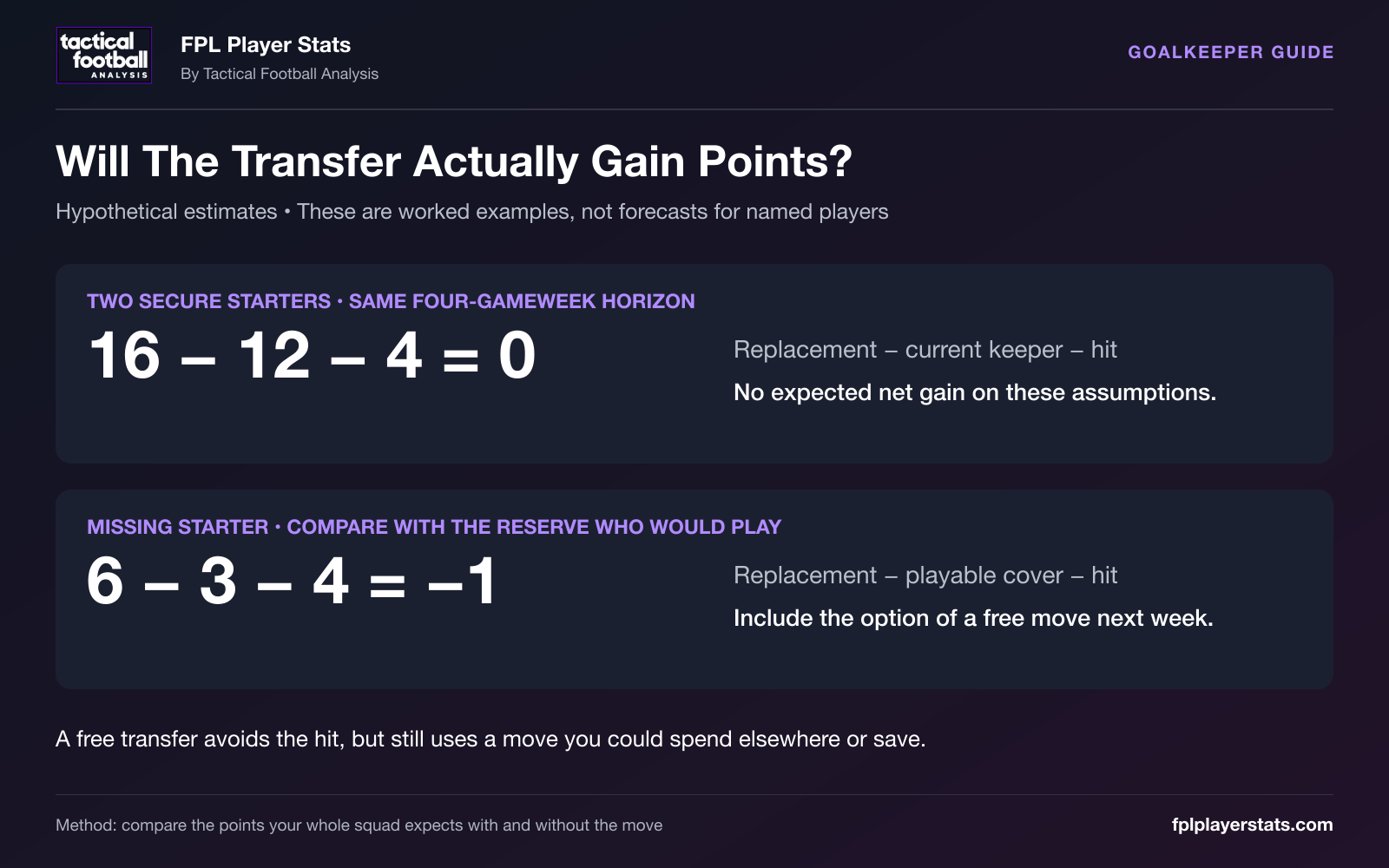
Two worked examples showing why the relevant comparison includes the goalkeeper or reserve who would otherwise play. Figures are illustrative estimates, not current player forecasts.
A missing starter changes the comparison, but check your reserve first. If that reserve is estimated at three points and the replacement at six this week, the immediate gain after a hit is 6 − 3 − 4 = −1. Compare the longer-term plan with using cover now and making a free move next week; do not count later gains that both plans would receive.
A free transfer avoids the four-point deduction but still has value elsewhere. Our Transfer Comparison tool helps examine the two players, while the practical FPL squad-analysis guide puts that move alongside injuries, captaincy and bench cover.
Use your own selling price when checking the budget. Raya's current buying price is £6.2m, but an owner who bought earlier may receive less when selling. The £1.6m buying-price gap to Verbruggen is therefore not automatically £1.6m released into your bank.
Check The Role And The Reserve Before Confirming
Nine league starts are useful evidence, not a promise of a tenth. Check the latest club update and FPL flag near the deadline, especially after an injury, managerial change or unexpected league omission. A return to training does not necessarily mean an immediate return to the XI.
Use the rotation research to put cup and league selections in context. A reserve appearing in a cup tie does not establish league rotation. Look at the league match before it and the next league selection rather than interpreting one cup appearance on its own.
The official FPL FAQs are useful for substitution and scoring edge cases. Your bench goalkeeper replaces the starting goalkeeper only if the starter does not play and the reserve does. An outfield substitute cannot fill the position.
On a Wildcard or other squad rebuild, compare the full pairing. A cheaper non-playing reserve saves money but leaves you exposed if the starter misses out. Two playing goalkeepers provide cover and choice, although the extra spend must be justified. Same-club cover uses two of your three available slots at that club, which can be costly at Arsenal if you also want their outfield players.
The Decision Before Gameweek 10
I would keep Raya or Verbruggen in a functioning squad. For a fresh budget purchase, Verbruggen merits the first comparison with Kinský: the former has the stronger points record, while the latter is cheaper and offers a useful run through Gameweek 13. Tzolakis is a less attractive new buy immediately before Arsenal away, but owners with more urgent repairs can reasonably hold.
Those judgements change if the starting role, fitness news, fixtures or use of the saving changes. Low ownership alone should not move a goalkeeper ahead of a better points prospect, and a popular choice should not be sold merely to make the squad different.
Keep every comparison in its own time window. A calendar-year review such as BBC Sport's review of the Premier League in 2024 is historical context; it cannot be combined with this season's first nine matches as though both describe current form. For recent form, compare the same team fixtures and include matches a player missed.
Start with the free player directory and individual profiles, then use the linked member tools when you need fixture planning, rotation research or direct comparisons. Before confirming a transfer, finish one sentence: this move improves my squad because of minutes, a better ownership window or a useful budget change. If the only answer is that another goalkeeper scored more last weekend, holding is still a serious option.