15 FPL Transfer Tips For Smarter Gameweek Decisions
Make better FPL transfers by weighing minutes, fixtures, selling value and points hits. Current Tavernier, Rogers and Palmer examples show when buying, holding or saving a transfer makes sense before Gameweek 10.
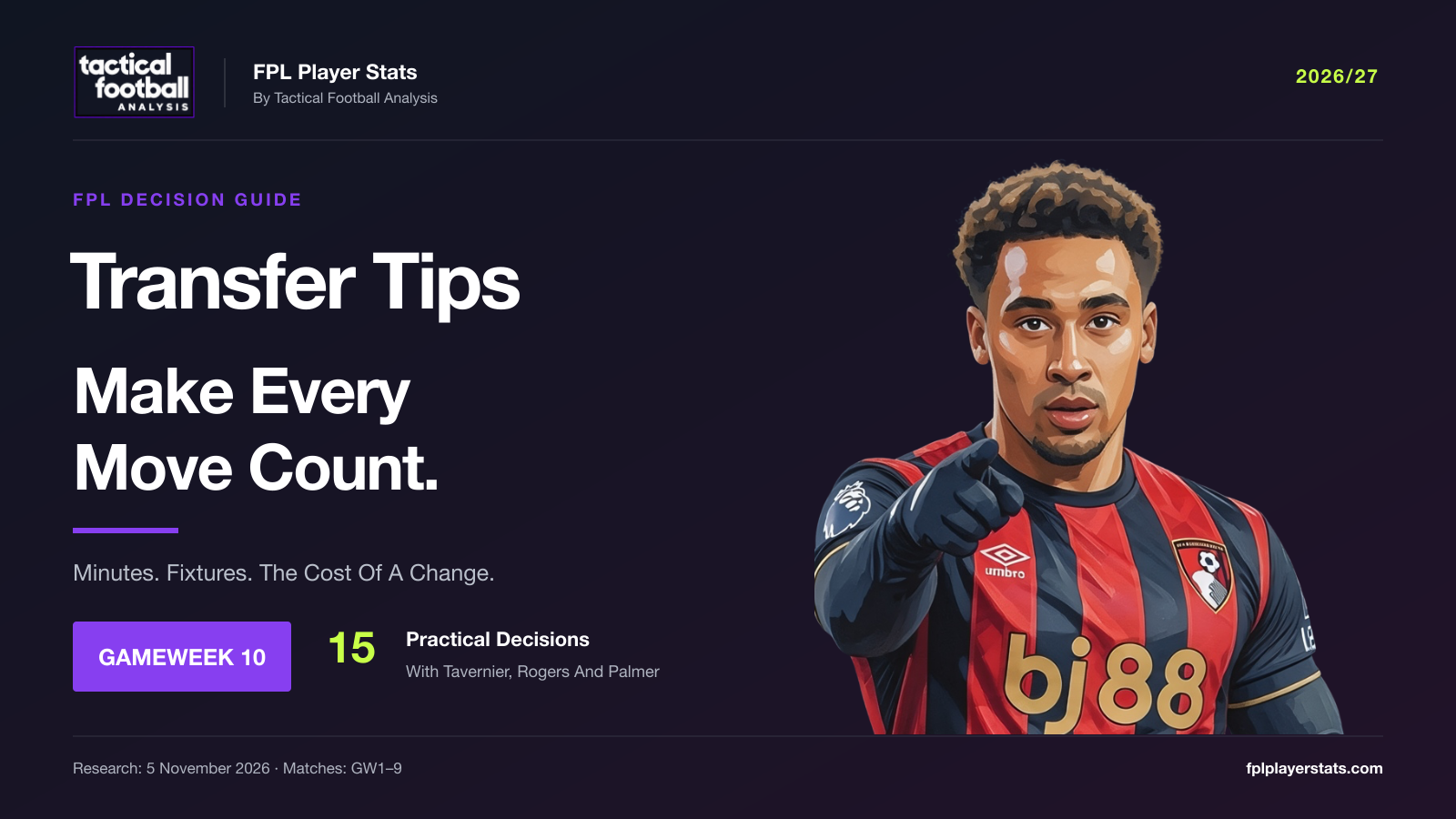
A free transfer is only useful if it improves the team you can actually put out. Before Gameweek 10, Marcus Tavernier offers a good example: he has followed two ten-point returns with three points, yet his latest appearance was also his first full league match since Gameweek 2. The score fell while the minutes improved.
That is why a transfer plan needs more than last weekend's points. These 15 FPL transfer tips connect the decision to minutes, chance involvement, fixtures and the cost to the rest of your squad, with current examples you can check for yourself.
Research checked on 5 November 2026 for 2026/27, before the Gameweek 10 deadline on Friday 6 November at 18:30 UTC. Match statistics cover completed Gameweeks 1 to 9 unless another window is stated. Gameweek 9 is now marked finished in the official FPL dataset. Prices and availability are a dated snapshot, so check them again before confirming a move.
1. Find The Problem Before Choosing The Player
Pick a provisional XI from your current squad first. A confirmed absence with no usable cover is a different problem from a fit midfielder who has blanked twice. The former may need a transfer; the latter needs a comparison.
Under the official FPL transfer rules, unused free transfers can accumulate to five. Rolling can therefore help you make a more useful pair of moves later. At the five-transfer limit, however, waiting does not build a sixth, so there is less benefit in saving purely to increase the bank.
Write down the job you need the purchase to do: replace a missing starter, release money for another position, improve the next four fixtures or provide a captain. If you cannot name that job, you may be shopping before you have identified a need.
2. Read Recent Minutes Alongside Season Starts
Marcus Tavernier costs £6.6m and has started all nine league matches for Bournemouth, playing 750 minutes. His last three appearances lasted 78, 86 and 90 minutes. That supports including him in a midfield shortlist, although nine starts cannot guarantee the tenth.
Open his public profile, choose Last 3 Fixtures, keep Home & Away selected and switch the chart to Minutes. The rising bars below show something the latest three-point return cannot: his recent playing time has increased.
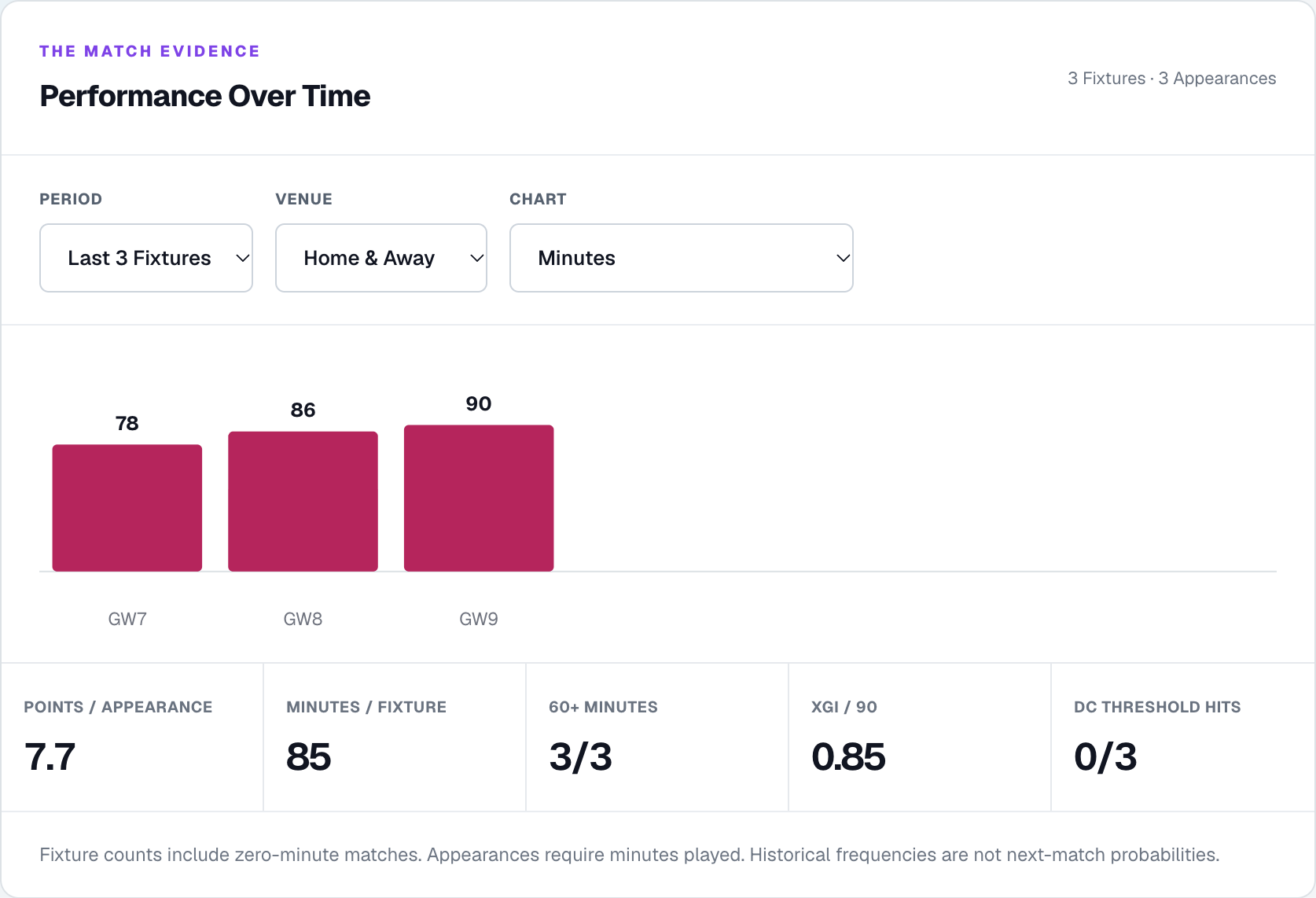
Genuine FPLPlayerStats capture on 5 November 2026. Tavernier, Last 3 Fixtures, Home & Away, Minutes; Gameweeks 7 to 9. The site's completed-match snapshot is dated 3 November and these minutes were checked against the official match history on 5 November.
Apply the same test to a player you own. A substitution while protecting a lead is not the same as repeated omissions. There is no universal rule that fewer than three starts in five makes someone a sale: injury recovery, opponent, role and the quality of your replacement all change that judgement.
3. Ask Where The Attacking Numbers Came From
Tavernier's 3.71 expected goals and 1.36 expected assists give him 5.07 expected goal involvements across the season. His five actual goals have helped produce 55 points, but that finishing return should not be treated as his future scoring rate.
The recent sample needs care too. His 2.41 xGI over Gameweeks 7 to 9 contains 2.28 from the first two matches and just 0.13 against Leeds in Gameweek 9. A strong three-match average can hide a quiet latest performance. Neither one quiet match nor two hauls should settle the transfer alone.
The FPL attacking statistics help separate shooting threat from creation. Compare the same team fixtures for both candidates, including matches they missed. A high per-90 rate from limited minutes is less useful if the player rarely gets enough time to turn it into points.
Football context explains why the chances might continue. Our analysis of Bournemouth's European win at Real Sociedad shows Tavernier in an attacking midfield role in Marco Rose's narrow shape. It is a specific tactical example, not proof that every league match will use the same arrangement. Check that the current role still supports the numbers.
4. Separate A Good Buy From A Sensible Hold
Morgan Rogers is £8.2m, while Cole Palmer is £9.8m. Both play for Chelsea, so switching between them does not change the fixtures. It changes the price and the mix of attacking responsibilities you own.
Midfielder | Price | Minutes, GW1 To 9 | xGI, GW1 To 9 | xGI, GW7 To 9 |
|---|---|---|---|---|
Tavernier | £6.6m | 750 | 5.07 | 2.41 |
Rogers | £8.2m | 790 | 4.22 | 1.02 |
Palmer | £9.8m | 788 | 3.62 | 1.45 |
Official FPL player data and match histories, retrieved 5 November 2026. xGI is expected goals plus expected assists. The last column is a separate three-gameweek sample, not another season total.
Rogers has the stronger season xGI at a £1.6m lower buying price, but Palmer leads their most recent three-gameweek comparison. Palmer's 1.03 xGI in Gameweek 9 accounts for much of that recent advantage. Those windows tell a more useful story than declaring either player superior from one total.
For a fresh Chelsea purchase, Rogers deserves the first value comparison when the saving improves another starter. For a Palmer owner, a sideways sale needs a specific use for the released money, especially after stronger recent involvement. If your existing midfielder remains useful and the saving would sit unused, holding is a serious option.
5. Buy An Ownership Window You Can Use
Tavernier's next four scheduled opponents are Ipswich away, Nottingham Forest at home, Fulham away and Brighton at home. That gives a new purchase a purpose beyond the immediate Ipswich fixture. Chelsea's corresponding run is Sunderland away, Leeds at home, Nottingham Forest away and Crystal Palace at home.
Use the fixture research page or the public profile's fixture strip to compare the period you expect to own each player. If a Wildcard is planned sooner, shorten the comparison. If you expect a long hold, extend it.
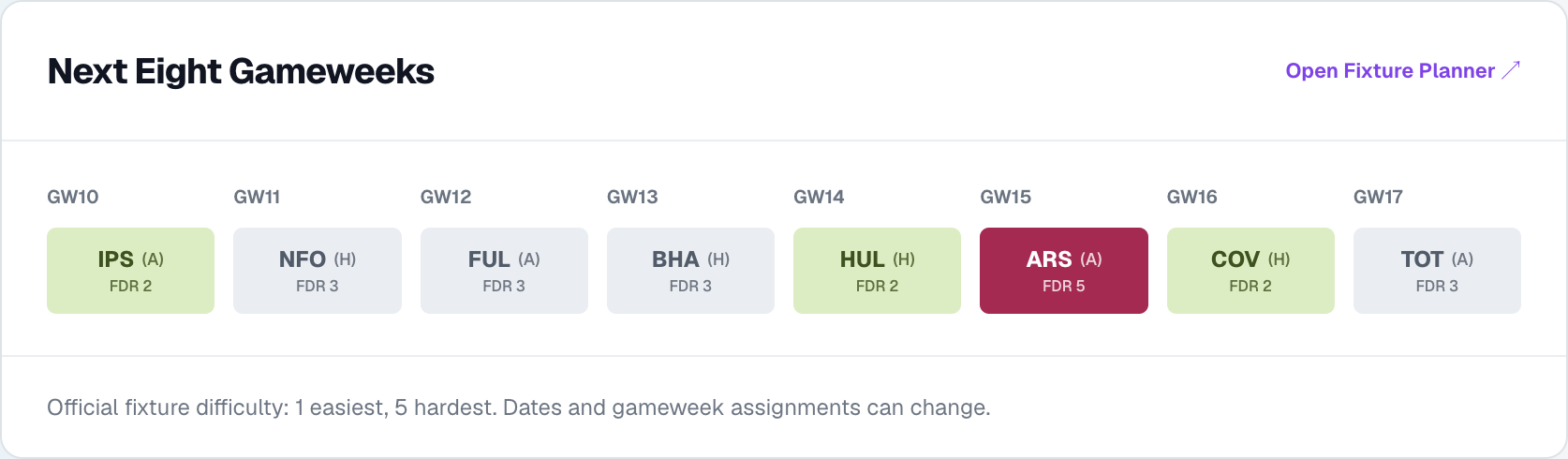
Genuine public-profile capture on 5 November 2026, showing Bournemouth's scheduled Gameweeks 10 to 17. Fixtures were checked against the official feed. FDR is the official 1-to-5 difficulty scale, not a prediction of Tavernier's points.
The longer view also shows Arsenal away in Gameweek 15 between more manageable fixtures. That may be a bench decision rather than a compulsory sale. A transfer plan that requires another transfer after every difficult opponent uses flexibility quickly.
6. Make A Points Hit Beat The Real Alternative
The official FPL rules on transfers charge four points for each move beyond your free allocation. The incoming player must improve your squad enough to cover that cost, rather than merely score four points himself.
Suppose, in a hypothetical example, your estimates over the same three gameweeks are 17 points for the replacement and 14 for the player you own. Paying four points gives an expected net change of 17 minus 14 minus 4 = minus 1. The higher individual forecast has not justified the hit.
If the outgoing player is injured, compare the purchase with the substitute who would actually start. Also compare buying now with using cover and making a free move next week. Once both plans own the same player, later points are shared benefits and should not be counted as extra profit from the early hit.
7. Budget With Your Selling Price
Buying prices do not tell an owner how much cash a sale will release. If you bought a player for £6.0m and his current market price is £6.4m, the normal selling value is £6.2m because you retain half the rise, rounded down to £0.1m increments.
That is why the £1.6m buying-price gap between Palmer and Rogers is not automatically the amount every Palmer owner banks. Check the selling value in your own Transfers page, add the money already available, then test whether the second move is possible. The official FPL player list is useful for current purchase prices and positions, but your squad supplies the sale value.
8. Treat Price Information As A Constraint
Waiting is valuable when a remaining match or press conference could change the transfer. Moving early is more defensible when a price change would genuinely block a well-supported plan and you are willing to accept the information risk.
The official game now provides price-change progress and likelihood information for 2026/27, as explained in its current FAQs. A likelihood label still does not establish the player's fitness or make the purchase a good one.
Write down a cheaper fallback before the price becomes a problem. If that fallback is almost as suitable, preserving the option to react to team news may be worth more than protecting £0.1m. Do not let a possible rise turn an optional upgrade into an urgent purchase.
9. Check Availability Again Near The Deadline
Tavernier, Rogers and Palmer had no availability warning in the official snapshot used here. That describes the feed at the time of research; it is not confirmation of their next start or of news that arrives later.
Check the latest club update after remaining matches and press conferences. Separate a confirmed absence, a late assessment and a return to training. They have different implications for your bench and for the minutes you can reasonably expect.
A well-covered owner can sometimes wait through uncertainty that a new buyer should avoid. Captaincy needs its own check: keeping a doubtful player does not oblige you to trust him with the armband.
10. Keep Next-Gameweek xP In Its Own Window
Tavernier's official next-gameweek expected points were 6.0 for Gameweek 10 at this research check. The public profile shows that measure separately from his historical points. It is a one-round estimate, not a promise and not a four-week forecast obtained by multiplying it by four.
For a longer transfer, look again at minutes, opponents and role over the intended ownership period. Keep official FPL xP distinct from any TFA model projection. If a very small change in expected minutes reverses a recommendation, the decision is close whatever the decimal ranking suggests.
11. Judge Premium Spending Across The Whole Squad
The expensive player needs to justify the compromises made elsewhere. A premium attacker who gives you a credible captaincy option can be worth more to your squad than another expensive player you would rarely captain.
Compare the complete combinations you could afford. A cheaper midfielder plus a dependable starting forward may suit your team better than a premium midfielder plus a reserve who rarely plays. Conversely, a saving has little practical value if there is no useful place to spend it.
Our practical squad-analysis guide develops that wider comparison. Start with the revised XI and bench, then ask whether the headline purchase has actually improved them.
12. Investigate Rotation Rather Than Guessing It
A player starting in a cup tie is a reason to inspect his workload and competition, not automatic evidence that he will miss the league match. Look at starts, substitutions, recovery time and the alternative player in his position.
The linked fixture-congestion analysis discusses three games within eight days as a workload marker. It is background reading on squad depth, not a current FPL team-news source or a prediction about any individual player's selection.
Use the FPL rotation research to examine the schedule alongside actual selections. A high-upside player with some minutes risk can still be a good pick, but he fits less comfortably in a squad already relying on several doubtful starters.
13. Verify Doubles And Blanks Before Planning Around Them
The official fixture feed currently assigns one match to each club in Gameweek 10. There is no double-gameweek advantage to build into these examples. Recheck assignments when planning further ahead, especially after cup scheduling or postponements.
In a confirmed double, assess the chance of appearing in both matches. In a blank, count the legal starting XI your squad can field before deciding that a chip or hit is necessary. Two scheduled fixtures do not guarantee twice the minutes.
The official FPL Team of the Week records successful past selections; it is not a fixture-planning page. Use the official fixture feed for the schedule and keep a retrospective points ranking separate from your next transfer.
14. Match The Chip To How Long The Problem Lasts
A Wildcard suits a squad you want to change for several gameweeks. A Free Hit suits a temporary problem when you want the original squad back afterwards. Several injuries do not automatically demand either chip if normal transfers and usable cover can solve them.
There are two sets of chips in 2026/27, one for each half of the season. The Premier League's chip guidance explains that structure. First-half chips must be used before the Gameweek 19 deadline and cannot be carried into the second half.
That expiry matters to your plan, but it does not make Gameweek 10 the automatic time to act. Build the proposed squad first, check the chip conditions in the live game and make sure the change solves more than the frustration of the last result.
15. Finish With A Shortlist And A Reason To Act
Before Gameweek 10, Tavernier merits consideration when a £6.6m midfielder's saving improves the rest of your XI. His starts, recent minutes and next four opponents support the comparison. The caution is that his chance involvement has been uneven, so a couple of ten-point scores should not become the expected weekly return.
Rogers offers a more expensive route into Chelsea's upcoming run. Palmer's stronger recent xGI is a reason for owners to assess the current evidence before spending a transfer on the cheaper team-mate. None is a compulsory purchase for a squad that already has credible starters and more urgent work elsewhere.
Keep a primary target and one affordable fallback, with the evidence that would rule each out. Use the free player profiles at FPL Player Stats for the match record and fixtures; the linked comparison, fixture and rotation tools require TFA membership.
Before confirming, check the deadline, latest availability, selling values, transfer cost, captain and bench order. Then complete one sentence: this move improves my squad because of the minutes, the ownership window or what the saving lets me do elsewhere. If the case still rests mainly on last week's score, keeping the transfer remains a useful decision.