
Pascal Groß For FPL Gameweek 6: Is Brighton’s Value Worth The Risk?
Groß’s role and Brighton’s attacking form make a persuasive case for Gameweek 6. We weigh the underlying numbers, fixtures and minutes risks before buying.
Watching a player collect another big return while his price rises can make a transfer feel more urgent than it really is.
Pascal Groß is giving FPL managers plenty to think about in that respect.
At £5.8m, with 47 points after five matches, the Brighton midfielder offers a route into an attack that has started the season impressively without taking a large share of the budget.
The difficulty is deciding what we are buying from this point onwards.
Those points have already been scored, and the next few weeks will ask different questions of Brighton.
There is a good case for bringing Groß in ahead of Gameweek 6, but it deserves more thought than simply following the most popular transfer.
This is an early assessment for the 2026/27 season, researched on 2 October.
The official Gameweek 6 deadline is Saturday 10 October at 11:00 BST, which is 10:00 UTC and 12:00 SAST.
There is still time for international availability news to change the decision.
Why Groß Belongs In The Conversation
Brighton’s attacking output is a useful place to start.
The Scout’s latest Wildcard analysis records 63 shots inside the box and 22 big chances across the opening five gameweeks.
That gives us a reason to look beyond the final scores.
Their attackers are being supported by a team that is regularly creating opportunities in dangerous areas.
Within that attack, Groß has several ways of becoming involved in a goal.
TFA’s analysis of Groß’s role under Hürzeler explains his creative influence from the right side of central midfield and the freedom to move towards the box.
That helps explain why his involvement can extend beyond the final pass.
His profile lists him as first choice for penalties, corners and indirect free kicks, and direct free kicks.
Those responsibilities matter because he does not need every promising attack to end with him arriving in the penalty area.
Delivery can bring an assist, while a penalty can turn an otherwise quiet afternoon into a useful FPL return.
He has also played all 450 available league minutes.
That is encouraging evidence of his importance to the side, particularly when we are considering a midfielder in this price bracket.
An affordable player who starts regularly can make it easier to spend elsewhere while keeping a usable option in the starting eleven.
There is a limit to what those five matches can tell us, though.
His involvement so far establishes a strong starting point.
It does not guarantee that the same minutes or set piece hierarchy will continue throughout a busier schedule.
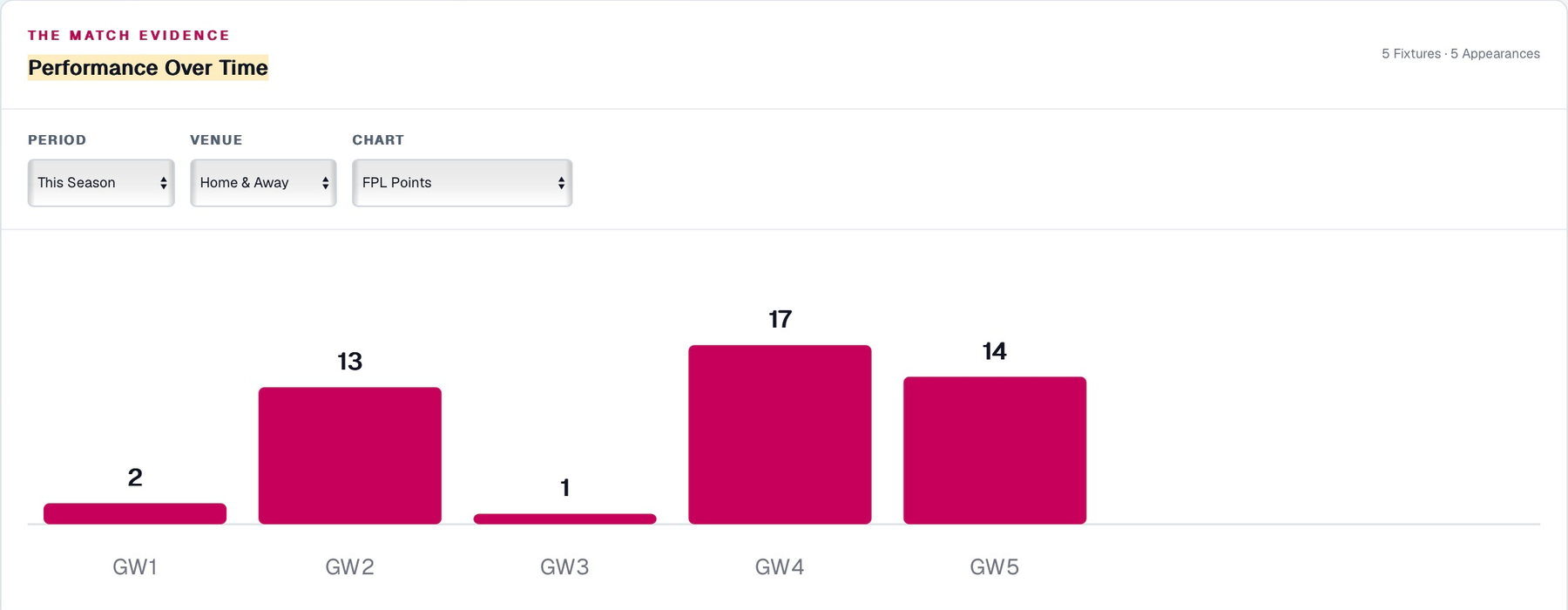
Groß’s FPL points in GW1 to GW5 of 2026/27.
FPL Player Stats filters: This Season, Home & Away, FPL Points.
Three large returns account for 44 of his 47 points, so the average hides two quieter matches.
What The 47 Points Might Be Hiding
Groß has three goals and four FPL assists, but his recorded expected goals and expected assists are 1.77 and 0.86 respectively.
Added together, that is 2.63 expected goal involvements, or about 0.53 per 90 minutes.
There is still useful attacking involvement here, although the gap between those underlying figures and the returns should temper expectations.
FPL assists and expected assists do not describe exactly the same thing, so this is not a calculation of how many points he has somehow been overpaid.
Nor does an impressive finish become irrelevant because its expected goal value was low.
The practical question is how much of the recent scoring rate we need him to maintain for the transfer to work.
At this price, a player can offer good value without averaging 9.4 points every week.
That becomes especially relevant if buying him releases money for a meaningful improvement elsewhere.
It is less convincing when the move requires selling a healthy midfielder with good fixtures, taking a points hit, or assuming that another large return will immediately pay for the disruption.
The Fixtures And Minutes Need To Be Considered Together
Brighton visit Sunderland in Gameweek 6 and then host Crystal Palace.
Away matches against Liverpool and Manchester City follow in Gameweeks 8 and 9.
The latest official fixture assessment gives those four matches difficulty ratings of three, two, four and five.
That sequence should affect how we plan the transfer.
Buying for the first two fixtures is reasonable if there is already a clear way to accommodate the next two.
It becomes harder to justify if the plan depends on immediately spending another transfer to remove him.
Fixtures will not prevent a player with his responsibilities from returning, but they can reduce the margin for a purchase that already needs several things to go right.
There is also the wider workload.
Brighton have seven matches across all competitions from 10 to 31 October, and the Scout’s Brighton assessment highlights returning midfield options as a possible influence on selection.
At 35, Groß could have his minutes managed.
How those rests are distributed between the league and cups is not yet clear.
This is where squad depth matters.
A reliable substitute helps when a player misses a match entirely, but offers little protection against a short appearance from the bench.
Managers who already own him can reasonably continue to back the role.
Managers buying now should be comfortable with that less predictable outcome as well as the attractive one.
De Cuyper Needs A Closer Look Than His Position Suggests
Maxim De Cuyper is a different decision.
His midfield role, despite being classified as a defender in FPL, gives him an appealing combination of attacking involvement and clean sheet points.
His current official price is £5.0m.
TFA’s analysis of Brighton’s opening match shows De Cuyper operating high on the left, with defensive cover behind him.
That gives useful football context to the appeal, although one match cannot settle his role or minutes for Gameweek 6.
His match history also shows why it helps to look underneath a season total.
Of his 1.55 expected goals, 1.47 came in Gameweek 1.
The four matches since then add up to only 0.08.
That does not make the advanced role meaningless, but it does make it difficult to describe his opening goal threat as something he has produced regularly.
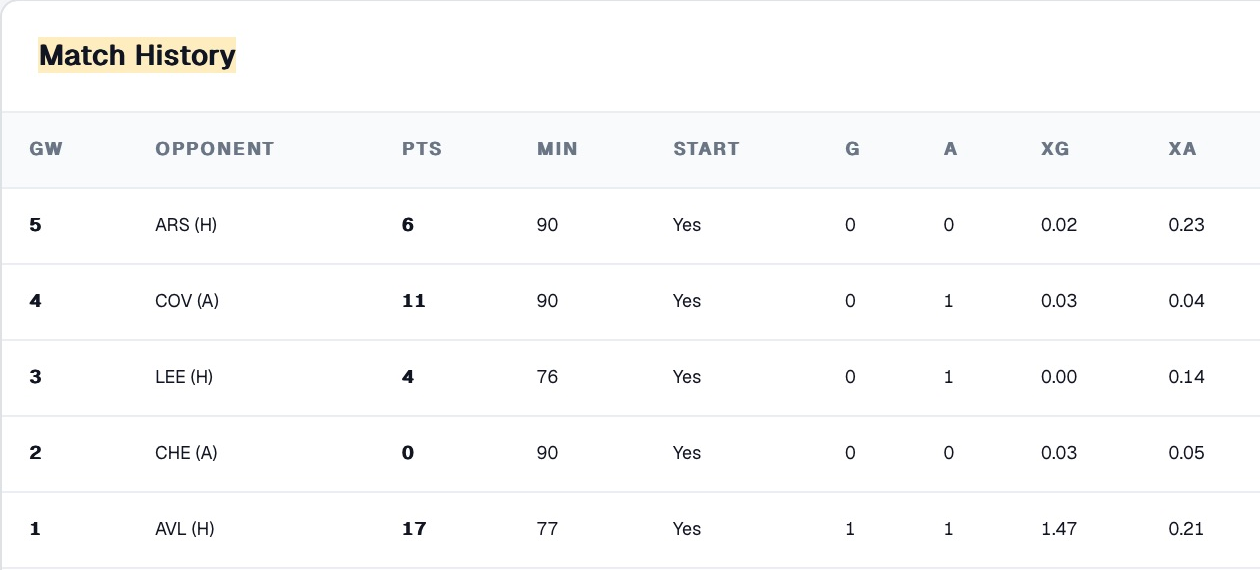
De Cuyper’s completed match history, cropped to show GW, opponent, points, minutes, starts, goals, assists, xG and xA.
Window: GW1 to GW5, 2026/27, home and away.
His 1.47 xG in GW1 contrasts with 0.08 across GW2 to GW5.
For managers who already own him, those figures alone would not be a reason to sell.
He has started all five games and still has creative involvement.
For a new buyer, however, the next fixtures make clean sheets a less comfortable assumption, while the attacking numbers deserve monitoring over more matches.
Buying Groß and De Cuyper together also means accepting that a disappointing Brighton performance could affect two positions in the same week.
Kostoulas Adds Another Selection Question
Charalampos Kostoulas has 28 points at £5.6m, with four starts and 353 minutes.
His 1.35 expected goals show some scoring opportunity, but three FPL assists alongside 0.06 expected assists are a reminder to examine the route to those points before expecting it to repeat.
Georginio Rutter returned as a substitute in Gameweek 5.
His availability gives the manager another option up front, so Kostoulas needs to be assessed on his own selection outlook.
Confidence in Brighton’s attack does not automatically mean equal confidence in every player’s minutes.
That is particularly relevant if a cheaper forward is being bought to fund another transfer.
The money saved only helps if the resulting squad still has enough dependable starters.
Requiring an attacking return from limited minutes is a much less forgiving position than having the flexibility to absorb a quieter week.
How To Approach The Gameweek 6 Decision
Groß has enough in his role, price and team’s attacking performance to remain a serious option.
A free transfer from a weak midfield position could make sense, especially where the budget released has a clear purpose.
There is less urgency for a manager whose current midfield is healthy and well placed for the upcoming fixtures.
Before buying, consider which player would leave, where any saving would be used, and whether the squad can cope if Brighton begin sharing minutes more widely.
Then check the final team news after the international break.
The official player panel showed no injury warning for Groß when checked on 2 October, but that is not a promise about his availability eight days later.
The early returns have earned Brighton our attention.
The useful decision now is how much exposure fits the squad we actually have.
Groß can be part of that answer without needing every manager to buy him, every owner to captain him, or every Brighton asset to follow him into the same team.