Line Up Prediction for FPL: How to Judge the Evidence

You've got a forward on your watchlist you don't own, a midfielder you do own who's been starting, and a predicted XI published on Thursday that names them both. The deadline is Saturday morning. The page tells you who's expected to play. It doesn't tell you what happens to your squad if it's wrong.
That's the decision in front of you. A line up prediction is a probability with a cost attached, and the buy, hold or bench call should turn on what a wrong start would cost you rather than on how confident the prediction sounds.
Here's the conditional view. Act on the predicted XI while it agrees with verified team news, and change the call the moment it doesn't. Nothing about a predicted lineup earns more trust than that.
Why a Predicted XI Is a Probability, Not a Start
The question is almost never whether a player is good. It's whether to spend on someone you don't own or keep someone already in your squad at the price you paid. A predicted XI is useful evidence for that call, and only for as long as it holds.
It also arrives days early. Predicted lineups are published well before the deadline, while confirmed team sheets land about an hour before kick-off, after your squad is locked. A player named on Thursday and the same player named in the confirmed XI on Saturday carry very different risk, and you're paying for the Thursday version.

The benchmarks are honest about the error rate. A 2024/25 Bundesliga evaluation comparing expert and swarm-intelligence providers reported a best overall accuracy of 84.32%, and an openly described Premier League prediction engine averaged 9.0 correctly identified starters out of 11 across 200 scored XIs (published lineup-prediction benchmarks). The two figures measure different things and neither guarantees accuracy for a particular club or Gameweek. Both imply roughly two misses per team.
Practical rule: judge a predicted XI by the cost of it being wrong, not by the confidence of the page that published it.
Everything here is written for the 2026/27 season, and any figure you carry into a specific Gameweek needs three things attached: the target Gameweek, the capture date and the statistical window it covers. The method is evergreen. The numbers aren't.
Three questions do most of the work:
Availability. How firm is the reported state, and how old is the report?
Role. Is this a secure starter, a rotation option, a returning player or a competing forward?
Minutes and chance statistics. What do recent minutes and expected numbers show over the stated window, kept separate from season totals?
A confident answer with no stated confidence behind it invites over-trust, and the habit of verifying AI answers across models transfers neatly to lineup pages: ask what evidence would make this wrong. Squad exposure to rotation is a separate question, and our rotation research tool is built for it. If the prediction agrees with confirmed team news, act. If it conflicts, bench or hold and price the alternative before the deadline.
Reading Availability Reports as Start Probability
A predicted XI carries a price even before it is right or wrong: start the flagged player and a short cameo can burn a transfer, a bench slot and the margin you saved for a reliable starter. Grade the reported state first, then decide what a wrong call would cost.
Reported state | What it means for the XI | Starting probability | Action before the deadline |
|---|---|---|---|
Ruled out | Not available for the match | Near zero | Replace before the deadline |
Unavailable for the squad | Long-term absence reported | Near zero | Sell or bench, and plan the replacement |
Fit enough to be involved, in contention | Back in the squad, competing for a place | Low to moderate | Start only with dependable bench cover |
Available, facing a managerial choice | Selection still open | Moderate, depends on late team news | Start only if no late concern appears |
Fully available, established starter | Expected to start | High but not certain | Start, and monitor rotation after cup or European matches |
The bands are editorial estimates rather than published figures. They grade evidence, and they age quickly once a club briefs again.
Ruled out and unavailable for the squad are the cleanest reads because they move the decision to replacement. The work is naming who enters the XI, who absorbs the bench risk and whether the freed money changes a later transfer.
Fit enough to be involved is where squads leak value. Back in the squad means competing for a place, and a substitute appearance has a different points profile from a start; if the wrong-start cost is a defensive bench or an extra transfer, the moderate band argues for cover even when the flag sounds positive.
What the Matchweek 1 reports showed
In the Premier League's predicted line-up coverage for Matchweek 1, Haji Wright was reported out for up to 12 weeks, Ephron Mason-Clark and Jack Rudoni had recovered from pre-season injuries and were in contention but unlikely to start, and Sunderland were reported to have every player available except Simon Adingra, who had not fully recovered from an ankle problem, while the manager still had starting decisions to make.
Those details belong to 2026/27 Matchweek 1 and should not be carried into a later Gameweek. What transfers is the grading: an absence can be priced near zero, contention stays conditional, and even a clean bill of health leaves the manager's selection unsettled.
Before the deadline: a chance-of-playing flag means the club expects the player around the squad. The manager still has to pick him.
Use the freshest official club briefing as the cutoff. If the report predates the last press conference, lower the band and price the bench or replacement before you commit.
Minutes and Expected Stats in the Right Window
A minutes figure with no window attached is unreadable. Season totals answer one question, recent samples answer another, and mixing them in a single comparison produces a conclusion neither supports.
Metric | What it supports | What it cannot show | Window to state |
|---|---|---|---|
Minutes played | Recent starting role and likely minutes | Future selection after a change of role | Recent-form sample, stated Gameweek range |
Season minutes | Overall reliability across the season | Current role after a tactical change | Season total, labelled separately |
Expected goals (xG) | Quality of chances a player receives | Goals scored or finishing skill | Season total and per 90, labelled as xG |
Expected assists (xA) | Quality of chances a player creates | Assists or a points return | Season total and per 90, labelled as xA |
xGI per 90 (xG + xA) | Combined chance involvement per 90 minutes | An FPL points forecast | Per 90 for the stated minutes |
Official next-gameweek xP | Expected points for the next Gameweek only | A multi-Gameweek forecast | Next Gameweek only, with capture date |
Season totals and recent samples answer different questions
Season minutes tell you how reliable a player has been across the campaign. A five-Gameweek sample tells you what his role is now. A midfielder with a heavy season total who has started the last two matches from the bench is a different asset from the one the season figure describes, and the recent sample is the one that prices the next fixture.
Expected goals and expected assists measure the quality of the chances a player receives and creates, not the goals and assists he has recorded. xGI is xG plus xA, and a per-90 figure only means something when you state the minutes it's calculated over. None of it is a points forecast.
A lineup tells you who the club intends to use, not what they'll produce. Researchers who used selected XIs as an input to forecasting team performance found heuristic models correctly identified 50% of Champions League teams finishing in the top four, while noting that accurate score prediction stays difficult even when outcome prediction is achievable (using lineups to predict team performance). Coarse outcomes are more predictable than precise ones, and a player's attacking return sits at the precise end.
Official next-gameweek xP covers one Gameweek. Use it as a single-week input and never as a multi-week forecast, because that's all it claims to be.
Where the numbers come from
Player prices, points, ownership, form, transfers and expected statistics all come from the official Fantasy Premier League data. Ownership, or TSB%, tells you what share of managers hold a player. It says nothing about whether the manager will pick him.
Each Tactical Football Analysis projection is labelled, and its method is explained beside the map, so you can see which window a figure covers before you use it. Our minutes research tool is where to check the sample before you compare two players on a per-90 basis.
Practical rule: state the metric, the window and the capture date beside every figure you use in a decision, or leave the figure out.
Role and Position Decide How Much a Lineup Can Tell You
How much a prediction can tell you depends on who it's predicting. A model tuned on one position doesn't transfer cleanly to another, and a single predicted XI covering all eleven shirts hides that.
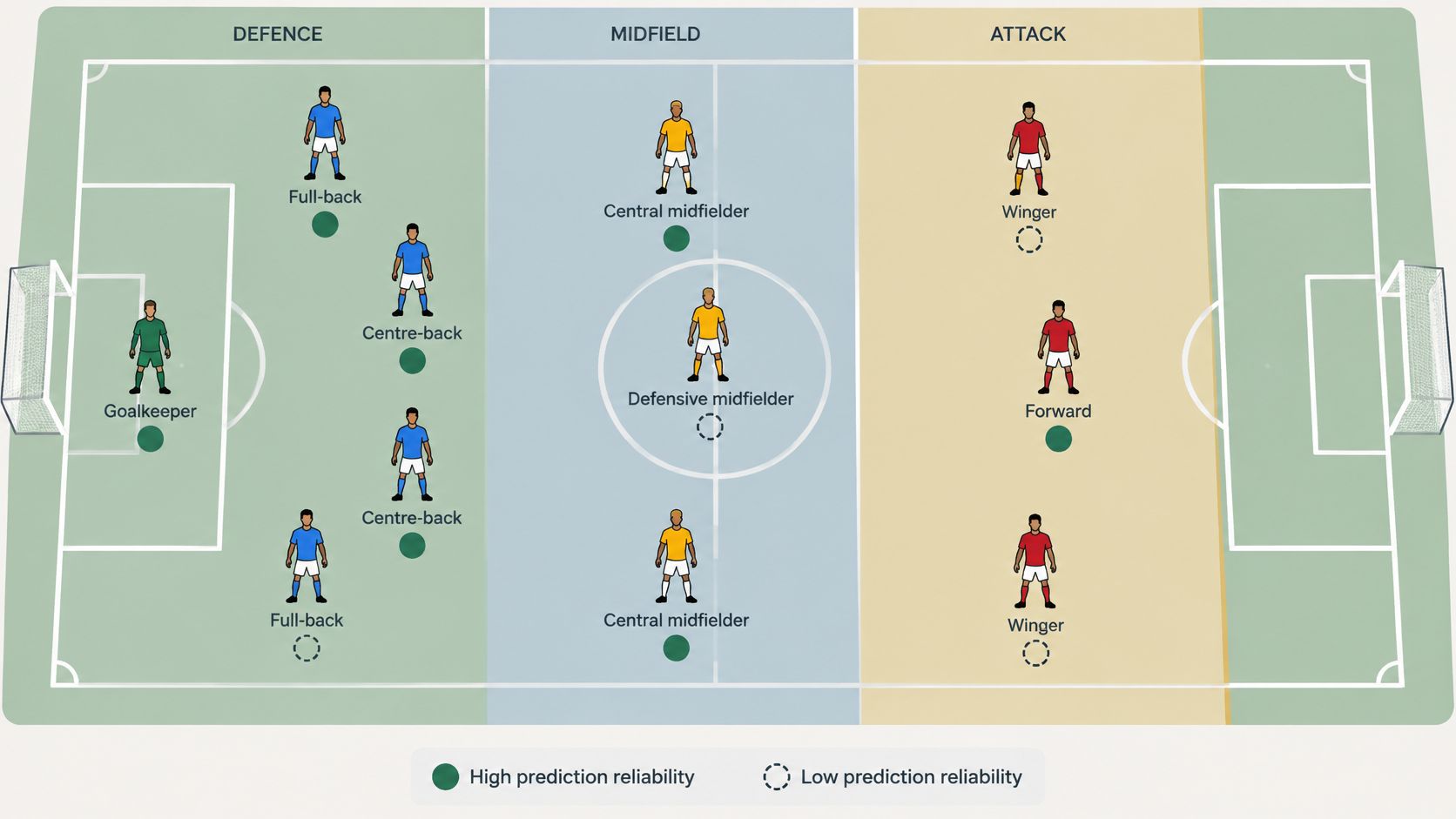
The evidence for that is direct. A football-specific machine-learning study used GPS-derived physiological variables with Recursive Feature Elimination and logistic regression to build a position-specific "line-up preparedness index" in research published in 2022 (Computers journal study). The method produced usable indices for full-backs, central midfielders and wingers, and the researchers reported unsatisfactory results for the remaining positions.
Recent starts alone won't carry the estimate. Combine position-specific selection evidence with injury status, workload, tactical fit and likely minutes.
Four role types and what each one is worth
Secure starter, 75 to 90 minutes. The lowest minutes risk in the game. Check whether he's routinely withdrawn once the result is settled, because that changes his clean-sheet exposure rather than his starting probability.
Rotation option in a congested run. The risk isn't whether he can play, it's whether he starts twice inside a week. Check his recent workload and the fixtures on either side.
Returning from injury. The selection evidence is thin because the sample is thin. Expect bench involvement and a ceiling near the hour until he's completed a full match.
Competing forward. Minutes swing between starts and substitute appearances, and the swing matters more here than anywhere else because so much of a forward's value sits in goals.
Convert the role into expected minutes instead of arguing about a binary. A player with a 0.6 chance of starting for about 80 minutes, a 0.3 chance of a bench appearance for about 20 minutes and a 0.1 chance of missing the match expects 54 minutes (0.6 × 80 + 0.3 × 20 + 0.1 × 0). A secure starter with a 0.9 chance of starting for about 85 minutes, with the remaining 0.1 treated as a missed match, expects about 77.
The gap between 54 and 77 is the argument for keeping starting, benching and missing as separate probabilities. It's also why a marginal starter with high substitution risk can be worth less than a dependable 90-minute player who does less with the ball.
Label every role estimate with its season and Gameweek window, then refresh it after the press conference and again once team news is confirmed.
Team News, the Deadline and the Cost of a Wrong Start
The Gameweek deadline sits 90 minutes before the first kick-off, and the game's administrators can change it, so check the official page rather than a remembered time (official FPL rules).
Confirmed lineups usually land after that deadline. A predicted starter is therefore a conditional choice, not a settled one, and the condition needs writing down before you lock the team.
Why the bench order belongs in the decision
The automatic substitution rule softens the risk without removing it. An outfield player who doesn't play is replaced by the highest-priority substitute who appeared, provided the resulting formation stays legal. A late omission can still change the shape you intended, which is why the bench order carries as much weight as the eleven.
Scoring sharpens the point. Appearance and clean-sheet points both turn on reaching 60 minutes, and stoppage time is excluded, so a player withdrawn between 59:00 and 59:59 can miss the threshold altogether (review of Premier League workload research).
The single call: start the likely 60-minute player when no late concern has appeared, and bench the doubtful starter when a dependable fallback sits in your bench order.
Check the bench order before the deadline, not after. The replacement is part of the decision, not something you tidy up once the team sheet lands.
Buying Versus Holding a Player Under Uncertainty
Two different decisions hide under one player. Buying him costs the purchase price, the budget you no longer have and, outside free transfers, a points hit. Holding him costs nothing at all.
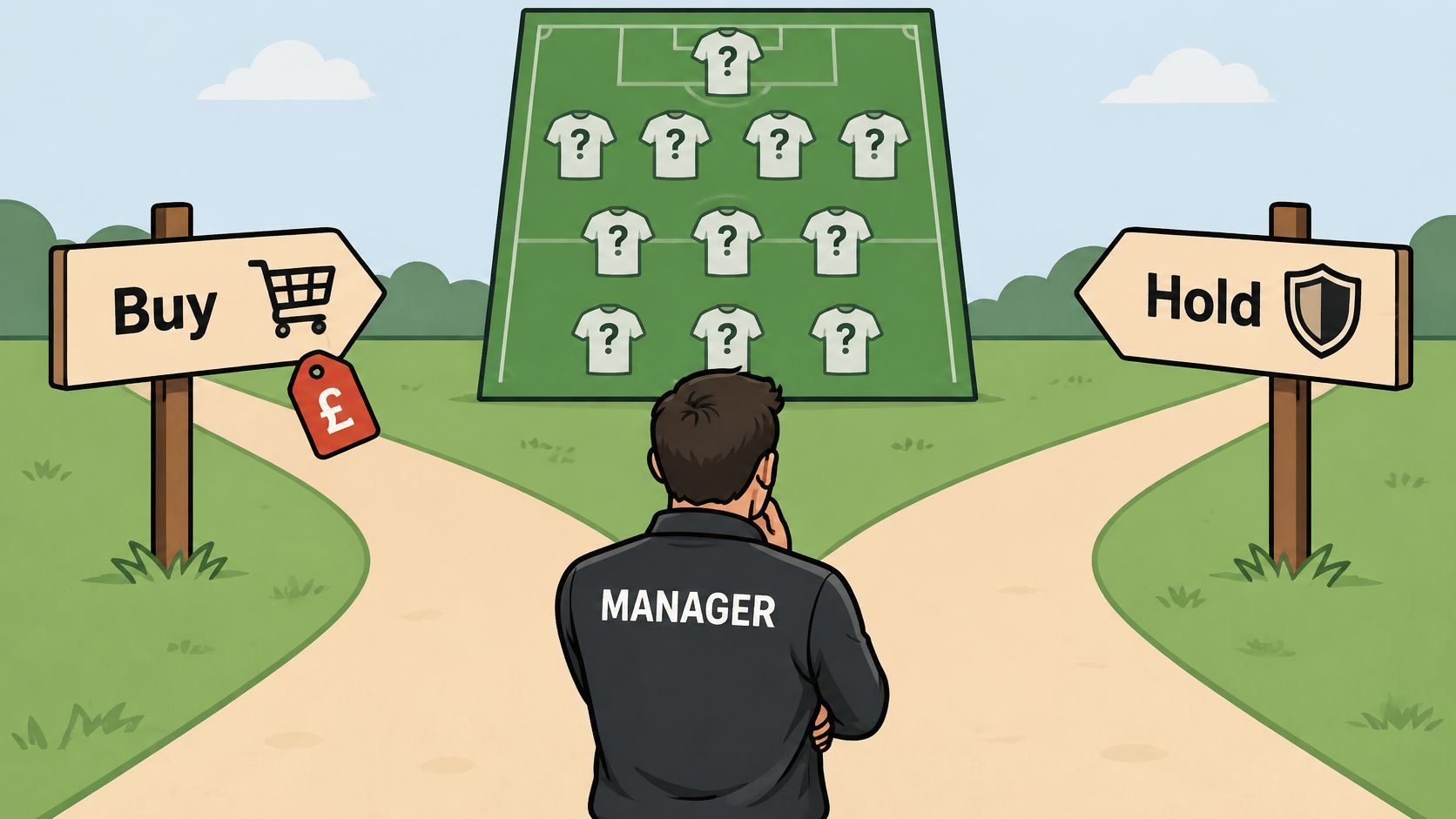
An existing owner can usually sit still. A sale is justified when the availability state is poor or the minutes are falling, because selling doesn't refund the hit you already paid to own him.
Price movement adds pressure a lineup page can't resolve. In 2026/27 the game introduced a daily price-change deadline at midnight UK time, with players rising or falling on transfer activity, and the official Price Change page warns that the information doesn't guarantee a change (2026/27 FPL changes). A speculative hit to chase a possible £0.1m is a bad trade on its own, whatever the predicted XI says.
Run the arithmetic instead. Say Player A is a confident starter with a 0.9 chance of starting into a difficult run, and Player B is a rotation option with a 0.5 chance into an easier one. If buying B costs a 4-point hit, B has to outscore A by more than 4 points across the window you're planning, otherwise the free hold wins.
Situation | Verdict | Condition to check |
|---|---|---|
Firm lineup evidence, stable minutes and a justified cost | Buy | Confirm bench cover and price risk |
Mixed evidence and a hit that is not worth paying | Hold | Recheck after confirmed team news |
Poor availability state | Sell | Name the replacement before the deadline |
Our FPL transfer tips guide covers the mechanics of a normal transfer week before you commit.
Confirm the Lineup Before You Lock Your Team
A predicted XI is only worth acting on when the last check still supports it. Narrow the pool first with position, price, minutes and availability filters, then run a short confirmation instead of reopening the whole decision.
Set the confirmation time. Use the latest pre-deadline window where a change is still actionable, and treat earlier noise as background.
Freeze the inputs. Record the start probability, the role assumption and the source time, so a late update triggers a targeted recheck rather than a full rebuild.
Price the miss. Convert a wrong start into a squad cost before locking: an unused substitute, a wasted captaincy, or a hit that cannot be refunded.
Write the flip condition. Name the single late event that changes the call and the default action when that event never comes.
Save the verdict. Keep one sentence for buy, hold, sell, start or bench, plus the reason, so the review after the Gameweek judges the process rather than the score.
The strongest confirmation is small: same probability, same role, same cost, and no new information that deserves to change any of them.
If the team sheet clears the stated risk and the miss cost stays acceptable, start him; if the probability drops or the cost rises past the written threshold, the prenamed fallback or hold is the disciplined call.