FPL Price Changes Explained for Transfer Plans

Buy before a possible rise only if the player already fits your transfer plan, because after the season starts an FPL price can move by £0.1m around midnight UK time.
The formula is undisclosed and an indicator isn't a guarantee, so buying before a rise shouldn't replace checking minutes, role, availability and fixtures.
The Transfer Decision Before Any Price Rise
If you'd reject the player without the price alert, don't make the transfer.
A possible rise can justify changing the timing of a good purchase, but it can't turn an unsuitable player into a useful starter.
Buy, hold or ignore
Buy earlier when the target already improves your squad, the transfer doesn't require a hit and you're comfortable accepting the outstanding team-news risk.
Hold an owned player when selling wouldn't fund a clearly better replacement or when the apparent gain hasn't increased your selling price.
Ignore the alert when the attraction is a prediction, crowd behaviour or fear of missing a small budget saving.
For a new buyer, the relevant question is whether the listed price buys the role and playing time the squad needs.
For an existing owner, the question is whether replacing that player improves the starting XI enough to justify spending a transfer.
Those are different decisions, even when both managers are looking at the same price-change indicator.
Solve the football problem first
If your squad lacks a playing defender, don't spend the available transfer on a speculative midfield purchase just because that midfielder appears likely to rise.
Equally, a cheaper forward isn't a practical solution if his uncertain minutes leave you relying on an already weak bench.
Our position, price, minutes and availability filters can remove players who don't fit the squad decision.
Minutes and role establish whether the target has a plausible route into your starting XI.
Fixtures and budget establish whether that route fits the wider transfer plan.
Availability and bench cover establish how much uncertainty you can reasonably accept.
If injury uncertainty could change the decision, wait for relevant official club reporting rather than treating midnight as a medical deadline.
A chance-of-playing flag doesn't confirm a start, and a favourable fixture doesn't resolve an uncertain role.
Use our practical FPL transfer tips to compare the proposed purchase with keeping the player you already own.
Keep the evidence within its limits
TFA projections are estimates, not official FPL forecasts, so use them as a comparison aid rather than proof that an early transfer will repay its risk.
This is an evergreen explanation, not a live shortlist or a recommendation for a named gameweek.
Any live recommendation needs official verification of club, price, FPL position, minutes, availability, fixtures and deadline, alongside the season, target gameweek, capture date and statistical window.
Transfer test: Protect the squad decision before protecting the price of the player you've been tempted to buy.
If the budget still permits the move after a possible increase, waiting remains a genuine option rather than a mistake.
If the increase would prevent it, assess the best affordable alternative before deciding that buying early is necessary.
The useful comparison is early target versus informed alternative, not early target versus an imagined missed opportunity.
How A Daily Price Change Is Decided
If you're trying to anticipate a change, follow transfer activity rather than treating the last match's points as a direct price input.
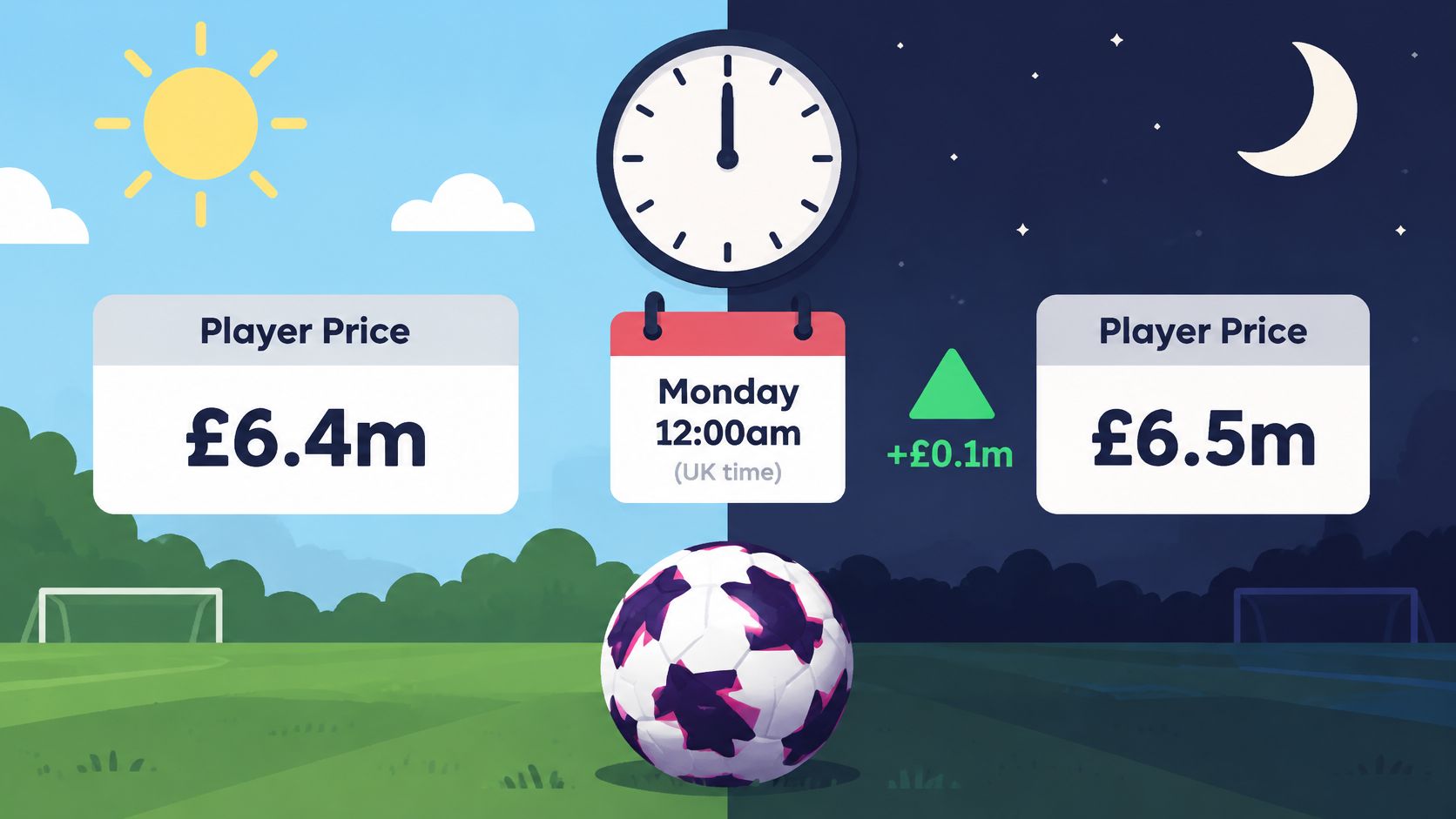
The official Fantasy Premier League rules state that prices don't change before the season starts, then may rise or fall by £0.1m per day, with changes possible around midnight UK time.
The same rules describe an undisclosed calculation using variable factors and warn that price-change indicators aren't guarantees.
Separate the match from the market
A player can produce a strong performance before managers decide whether to buy him.
Those subsequent transfer decisions create market pressure, while the completed-match record remains evidence of what happened on the pitch.
Match output helps you assess the player's performance.
Transfer activity helps you understand buying or selling pressure.
A confirmed price update tells you what the player now costs.
Think of managers moving through a turnstile in the same direction before the update, but don't assume you can see the game's trigger from the queue.
Because the calculation isn't disclosed, a visible transfer count isn't a switch managers can reliably pull.
The illustration below describes the mechanism, not a live player's valuation or a verified market capture.
Read the timestamp before the signal
Our player prices, points, ownership, form, transfers and expected statistics come from official Fantasy Premier League data.
Each tool shows its data timestamps, which lets you distinguish a current observation from a saved view.
If you're keeping transfer notes, record the capture time beside the price rather than copying the number without context.
Check the observation time before comparing market information from different screens.
Separate completed matches from market activity that continues afterwards.
Retain uncertainty when an indicator suggests a change but the update hasn't happened.
A player can attract buyers while questions about his tactical role, fitness or starting place remain unresolved.
That's why a rise supports a conclusion about demand, not a conclusion about his next appearance.
For team selection, use the football evidence to choose between starters rather than promoting the player whose market price has increased.
For captaincy, apply the same distinction, because buying pressure doesn't establish either secure minutes or superior scoring prospects.
How Far Prices Usually Move In A Gameweek
If your plan depends on several future rises, treat that funding as uncertain rather than already available.
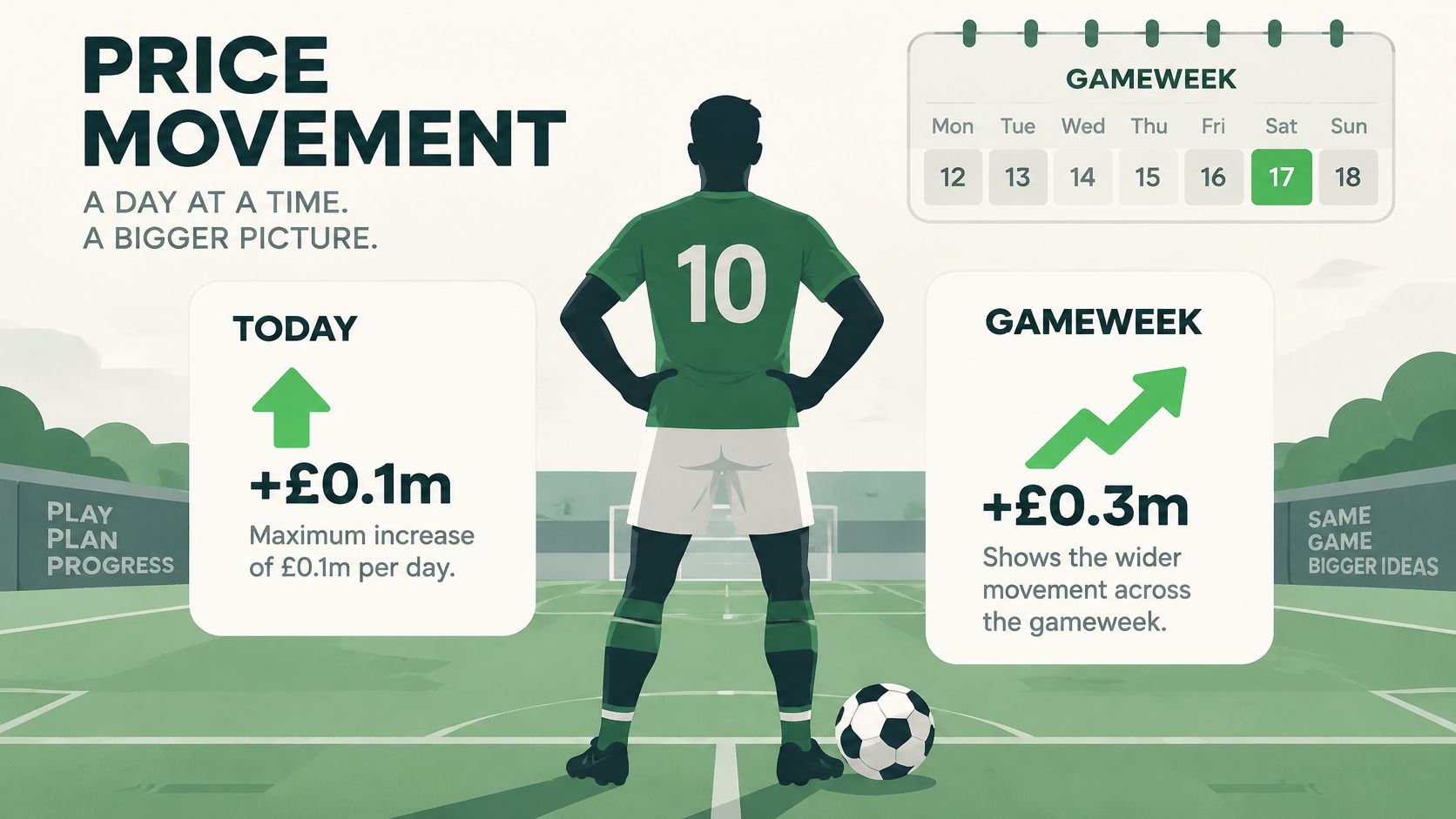
Premier League guidance describes daily rises or falls of £0.1m and says players have historically tended to move by approximately £0.3m across a gameweek.
That gameweek figure is an observed pattern, not a guaranteed cap or a forecast for the next window.
A pattern isn't a funding promise
The distinction matters when you're planning a later upgrade that only becomes affordable if your current player keeps attracting buyers.
You can monitor that possibility without committing the rest of the squad to it.
Confirmed movement can be included in the current budget.
Possible movement belongs in a contingency plan.
Historical movement provides context, not money you can spend.
The illustration should be read as an explanation of price movement rather than evidence of a guaranteed weekly sequence.
Keep market windows separate
If you record a player's movement across a gameweek, write down the dates covered by that observation.
Don't combine that record with a recent-form sample and describe the result as a single trend.
A price window measures changes in valuation, while a match sample measures performance over completed fixtures.
A useful budget plan still works if the next predicted rise doesn't happen.
Expected goals and expected assists describe chance involvement, not the likelihood that managers will keep buying the player.
Likewise, a market increase doesn't establish that the player's recent returns are repeatable.
For a manager planning ahead, the practical response is to keep an affordable alternative available rather than assuming continued increases will finance the preferred route.
Starting-price changes between seasons answer a different question and shouldn't be used to strengthen a short-term transfer argument.
The relevant judgement is whether today's affordable squad is strong enough, not whether a historical market pattern makes tomorrow's budget look more attractive.
How Much Of A Rise You Keep On Sale
If you're selling an owned player, calculate the selling price before deciding that you've banked the full increase.
The official FPL resale example gives a player bought for £7.5m, later listed at £7.8m, a selling price of £7.6m, because only half the increase is retained and that share is rounded down to the nearest £0.1m.
Work from your purchase price
The gain in that example is £0.3m, half is £0.15m, and rounding leaves £0.1m of usable profit.
The important comparison is therefore between what you paid and what the player now costs, not between today's price and somebody else's purchase price.
These worked cases apply the same official rule.
Purchase price | Listed price | Profit, kept share and sale price |
|---|---|---|
£7.5m | £7.8m | £0.3m profit, £0.15m kept rounds to £0.1m, sale £7.6m |
£7.5m | £7.7m | £0.2m profit, £0.1m kept, sale £7.6m |
£7.5m | £7.6m | £0.1m profit, £0.05m kept rounds to £0, sale £7.5m |
A small rise can therefore increase the player's displayed valuation without increasing the amount you receive on sale.
It can also leave a new buyer paying more while an existing owner has no additional transfer money.
Buying power isn't the same as displayed value
For a buyer, avoiding an increase preserves money at the point of purchase.
For an owner, benefiting from an increase requires enough retained profit to clear the rounding step.
Before buying, check the cost of the complete transfer plan.
Before selling, check the actual selling value shown for your player.
Before celebrating squad value, identify the replacement that the available money would fund.
This makes buying solely to catch a predicted rise a weak strategy, because the immediate display change may not create spendable profit.
It also makes selling merely to bank an apparent gain unreliable reasoning when the sale doesn't improve your replacement options.
Assess falls through the replacement budget
Don't assume the half-profit treatment gives equivalent protection against a price falling below what you paid.
For an actual sale, use the selling value displayed by FPL rather than estimating it from the latest headline movement.
A decline from an appreciated valuation needn't reduce your available budget in the same way as a decline below purchase price.
The practical question is whether the money released still buys the replacement you want.
If it does, and the owned player remains suitable for your starting XI, the market movement alone isn't a strong reason to spend a transfer.
Midnight Updates And The Gameweek Deadline
If waiting could resolve meaningful team-news uncertainty, compare that information with the specific transfer route you might lose.
Premier League price-change guidance says heavily bought players can rise by £0.1m per day, heavily sold players can fall by the same amount, and updates may occur at midnight UK time.
That update is separate from the gameweek deadline for transfers and team submission.
Moving early buys budget certainty
Buying earlier secures the target at the price available when you confirm the move.
It doesn't secure his starting place or protect him from an injury in a subsequent match.
The benefit is preserving an affordable transfer route.
The cost is committing before potentially useful information arrives.
The safeguard is checking intervening fixtures and whether your bench can cover a problem.
If you're buying for a later gameweek, be particularly clear about why you need to commit now.
An attractive future fixture doesn't automatically outweigh uncertainty before the player is required.
Use our research watchlist to keep the preferred target and an affordable alternative within the same planning process.
Waiting buys information
Waiting can allow official club updates, intervening matches and clearer selection evidence to influence the decision.
It can also leave the preferred transfer unaffordable, so waiting isn't cost-free because it feels more cautious.
Check the need by deciding when the player must enter your starting XI.
Check the evidence through availability, expected minutes, role and the relevant fixture.
Check the constraint by testing whether a price movement breaks the plan.
If a points hit becomes necessary, require a football case that stands independently of the price saving.
Don't convert a budget concern into a points deduction to preserve the original shortlist.
Keep captaincy separate from transfer urgency
An early purchase doesn't oblige you to captain the player.
Continue comparing the available captaincy options using expected involvement, availability and fixture context before the gameweek deadline.
Waiting buys information, while moving early preserves today's budget route, and neither choice removes uncertainty.
The correct timing depends on which uncertainty matters more to your squad.
If the target is replaceable but the injury question is decisive, waiting is usually the more defensible choice.
If the player is already your preferred transfer and the budget is restrictive, accepting the information risk can be reasonable.
How To Watch Prices Without Chasing Them
If monitoring prices keeps changing your shortlist, reduce the process to checks that answer a specific squad question.
Start with the player you need, then use market information to decide whether timing deserves attention.
A monitoring routine with a purpose
Read confirmed ownership and transfer direction after the gameweek update rather than relying on an isolated predicted-percentage screenshot.
Check the official player record for price, position, status and availability before comparing the target with your squad.
Separate statistical windows by keeping season totals and recent-gameweek evidence in distinct notes with their dates.
Keep forecasts in scope by using official next-gameweek expected points only for the next gameweek.
Revisit the market near the update only when the transfer is already justified and the budget is restrictive.
Ownership, or TSB%, is the percentage of all FPL managers who own the player.
It describes how widely he is held, while transfer direction describes whether managers are currently moving towards or away from him.
Neither establishes that an undisclosed price-change threshold will be met.
Match the tool to the question
Use our FPL transfer trends to examine market direction without treating popularity as a selection recommendation.
For performance context, FPL Player Stats player profiles provide a separate place to examine a player's season and recent record.
Every individual player profile is free, alongside Differential Picks, Budget Picks and Form Plus Next Fixture.
The other 14 maps and nine FPL tools are available to paid TFA members.
Public profiles support checking the player's record before committing to a shortlist.
Member market data refreshes every 15 minutes, separately from live gameweek points, which refresh every minute.
Tool timestamps help you identify the observation you're using.
Those refresh schedules describe different information streams, not a guarantee that a price will change at the next update.
Keep forecasts out of price predictions
Our next-gameweek xP is the official expected-points value supplied by FPL, used unchanged.
It isn't a multi-gameweek forecast and doesn't estimate future price movements.
Historical expected goals, expected assists and derived xGI per 90 describe chance involvement rather than guaranteed returns.
If a predictor is the only reason you're considering a hit, stop and reassess the transfer.
A useful monitoring routine should make the existing decision clearer, not generate another unnecessary decision every evening.
What The 2026 Rise And Fall Windows Showed
If you use a reported price window as an example, treat it as evidence of market behaviour rather than a current shopping list.
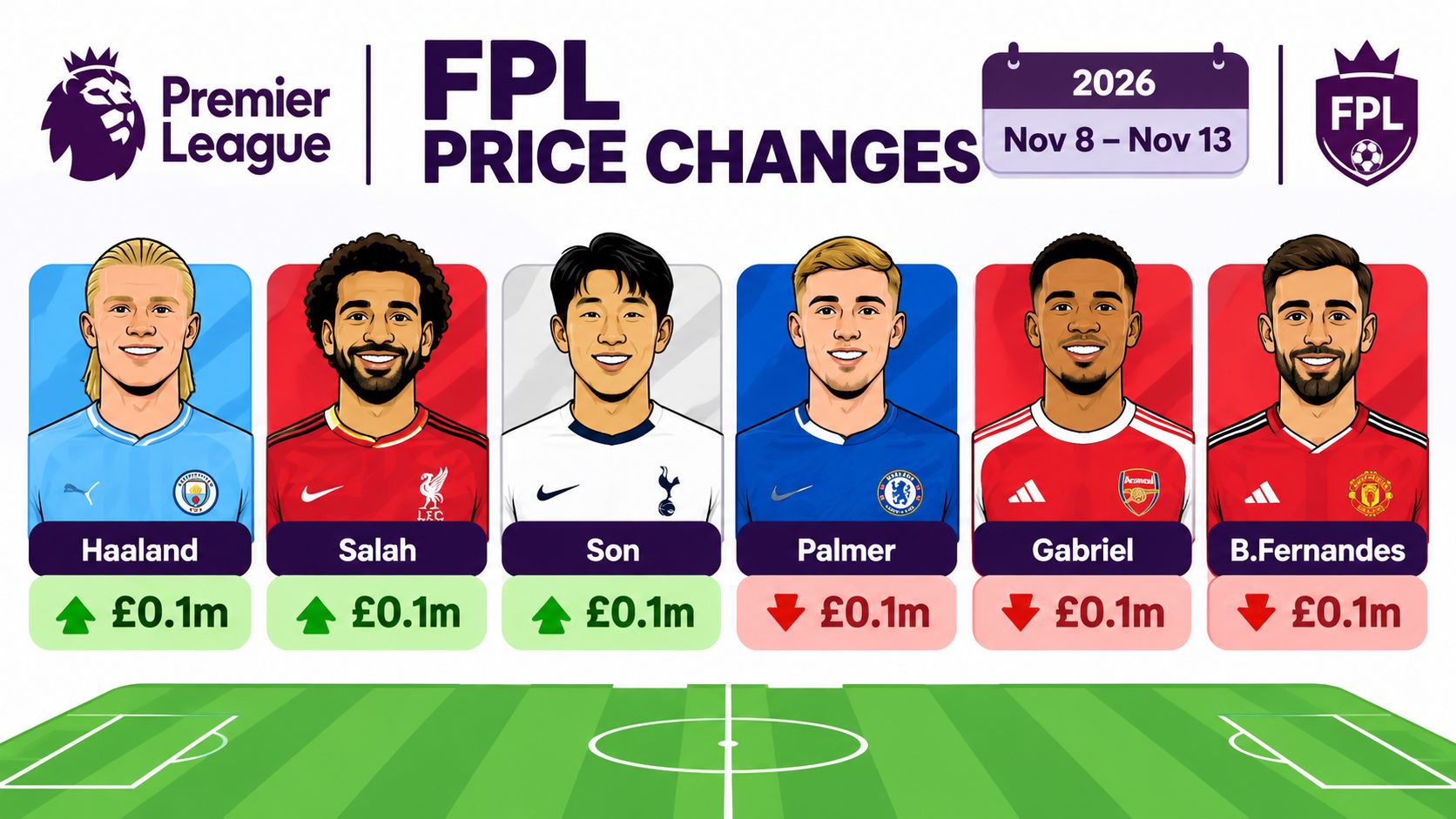
The Premier League's reported 2026 price-change window listed £0.1m rises for Ezri Konsa to £4.8m, Morgan Rogers to £8.2m, Antonio Silva to £5.1m and Mohammed Kudus to £6.6m.
Those are report-specific figures, not verified live prices or current transfer recommendations.
Read the reported window narrowly
The reported increases show that players at different price levels can move in the same update.
They don't establish that those players shared a tactical role, comparable minutes or equally attractive fixtures.
The accompanying illustration isn't a verified live-market screenshot, and its date range shouldn't be used as the statistical window for these examples.
In a separate reported 2026 example, The False 9 recorded Gibbs-White falling from £7.9m to £7.8m after 20,521 transfers out, representing 10.5% of the reported transfer activity.
That percentage describes the report's transfer-activity measure, not the percentage of all managers who sold him.
The examples below retain their separate reporting contexts rather than claiming that the fall occurred in the same window as the rises.
Player | Listed price | Change |
|---|---|---|
Ezri Konsa | £4.8m | +£0.1m |
Morgan Rogers | £8.2m | +£0.1m |
Antonio Silva | £5.1m | +£0.1m |
Mohammed Kudus | £6.6m | +£0.1m |
Gibbs-White | £7.8m, from £7.9m | -£0.1m, 20,521 transfers out, 10.5% of reported activity |
Apply different questions to owners and buyers
For an owner facing selling pressure, the useful task is checking whether the player's football prospects have changed and whether the replacement remains affordable.
For a non-owner, a lower listed price is only useful if the player already offers a suitable route to minutes and returns.
Owners should inspect their actual selling value and the quality of the replacement.
Buyers should investigate why the player is being sold rather than assuming a discount means value.
Both should avoid interpreting the movement itself as a points forecast.
Before these names are used in a live recommendation, editorial review must verify their clubs, FPL positions, prices, availability, minutes and fixtures against current official records.
That recommendation also needs its season, target gameweek, capture date, statistical window and deadline, none of which these isolated reports establish for today's decision.
The decisive non-owner question remains whether the player was already the right transfer without the price movement.
Before your next transfer, use FPL Player Stats to compare the target with your owned player, check the timestamps and record an affordable alternative, then confirm the move only if the minutes, role, availability and fixture case still stands without a predicted rise.