FPL Double Gameweek Guide: Planning Transfers and Chips

The most popular Double Gameweek advice is to buy every player who has two fixtures. That advice treats fixture count as the decision. It is not.
A transfer is justified only when the player is likely to use both matches, the double is confirmed, and the blank that often follows does not wipe out the gain. Holding a player you already own is a different decision from buying one. A hit for an unconfirmed second fixture is usually the expensive mistake.
Decide Between Holding and Buying First
Hold a nailed starter you already own when both fixtures are confirmed and his minutes look secure. Start him. Captain him only if the role, not the extra fixture, supports the armband.
Holding costs nothing beyond the chance to upgrade someone else. Buying spends budget, and a move beyond your free transfers spends points before either match is played. A new name therefore needs a stronger case than a player already in the squad.
Situation | Lean | Condition to Check |
|---|---|---|
Owned, nailed starter with two fixtures | Hold and plan to start or captain | Both fixtures confirmed and minutes secure |
Owned, rotation-prone player with two fixtures | Hold only if minutes stay secure | Consider a planned sell when starts are uncertain |
New buy, confirmed double and secure starter | Buy when the second fixture adds real upside | Budget and replacement cost |
New buy, double still provisional | Wait for confirmation | Avoid a points hit for an unconfirmed fixture |
Owned player who blanks the following gameweek | Plan an exit or chip before the blank | Bench cover and Free Hit timing |
Say you already own a £6.5m midfielder who is expected to start both matches. A £5.0m option with the same club badge is on the bench most weeks and might appear once. The cheaper player does not become the better buy because the headline says two fixtures. The £1.5m you would free is useful only if it upgrades a starter you will field.
Role and expected minutes outrank the headline fixture count. A rotation-prone player you own can stay if recent team sheets still show him starting. Sell him in the plan, not in a panic, when one of the two matches is the one he is likely to miss.
A new buy with a confirmed double and a secure role is the cleanest purchase, and only when the second match adds real upside after price and the player you sell. If that double is still provisional, wait. Do not pay a hit for a fixture that can move.
An owned player who then blanks needs an exit or a chip before that blank, not a celebration of the double alone.
Before the deadline, list every squad player with two fixtures. Label each one nailed, rotated or doubtful. Every status has to be checked against official Fantasy Premier League data on the capture date, because a flag is not a team sheet.
Confirm the Double Gameweek Before You Act
An FPL Double Gameweek is a scoring period in which at least one Premier League club plays twice, so players from that club have two chances to collect points, as the official FPL help pages define it. A normal schedule contains 10 fixtures because all 20 clubs usually play once, so a Double Gameweek contains more than 10 fixtures.
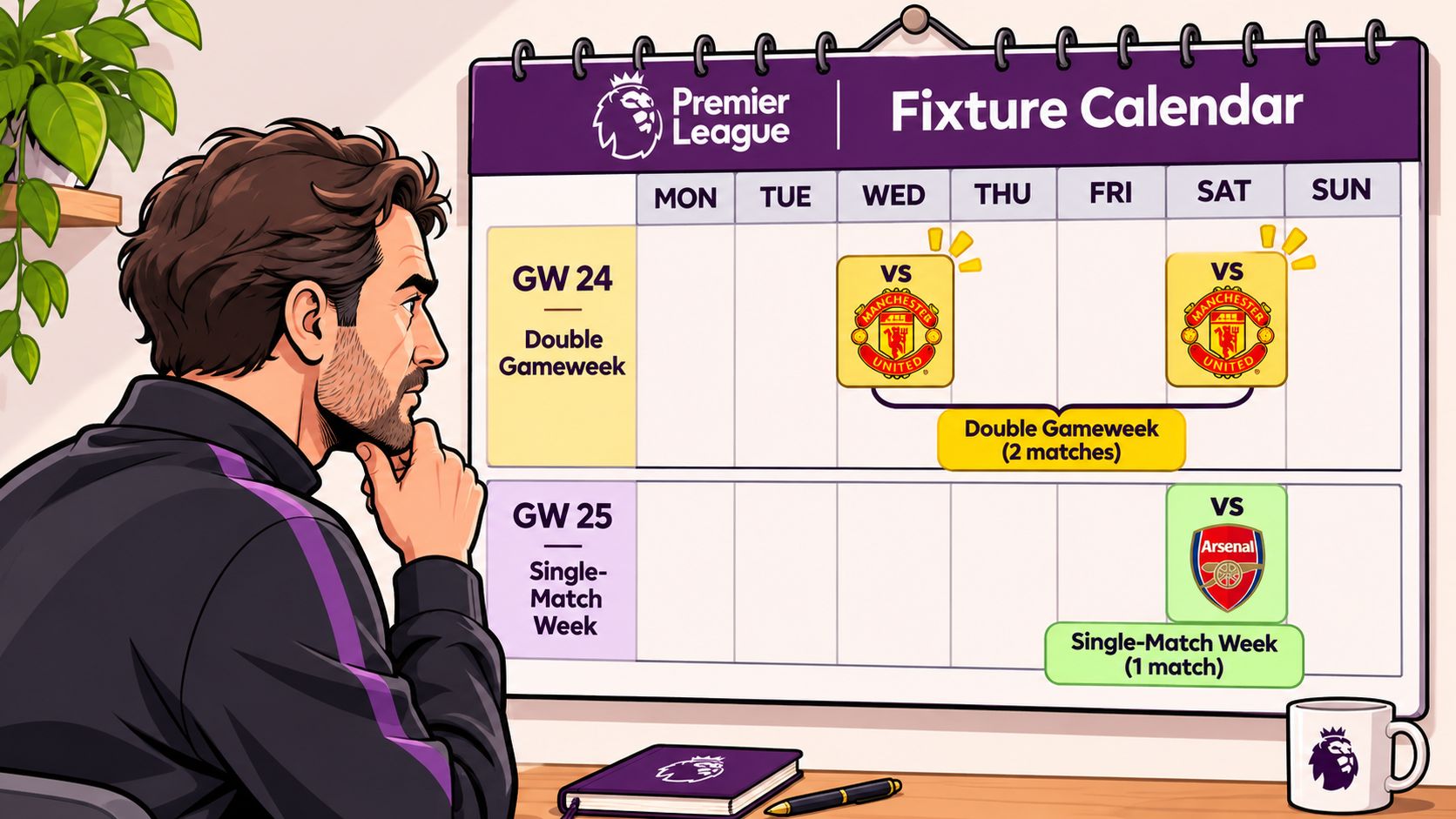
The definition does not require every club to play twice. It applies whenever some teams play more than once in the same Gameweek, so a double can involve a small group or several clubs.
What the 2025/26 calendar showed
The Premier League identified six clubs playing twice in Double Gameweek 33 of the 2025/26 season in its season briefing, so managers could select players with two scheduled fixtures from those six teams. Such doubles generally appear when postponed league matches are rearranged into an existing Gameweek, often after cup ties or other clashes.
A player from a doubling club can receive points from two matches. A player from a non-doubling club has one scheduled opportunity. The extra fixture only creates an opening; fixture difficulty, minutes and rotation decide whether that opening becomes points.
Expected is not confirmed
Official 2025/26 planning material described Gameweeks 33 and 36 as expected Double Gameweeks because midweek dates did not clash with European competitions, while cup progress could still move a match and change DGW33. A later official confirmation established a DGW36 for Manchester City and Crystal Palace after a postponed match was rescheduled into that midweek.
Treat an expected double and a confirmed double differently. An expected one can shape shortlists and transfer timing. A confirmed one can support a purchase after its price, your outgoing player and the following fixture have been checked. Do not pay a hit while the second match can still move.
Practical rule: Confirmation comes from the fixture being scheduled in the Gameweek, not from a favourable calendar projection.
A second fixture is only one side of the deal. If the rearranged schedule leaves the player without a match immediately afterwards, that blank is part of the transfer cost and may require another move or bench cover.
The 2025/26 examples explain the mechanism only. They are not the live 2026/27 list. Check the current fixture research view against the official list before you move.
Data Point | Source | Check Before Acting |
|---|---|---|
Club fixtures in the target Gameweek | Official Premier League and FPL fixture list | Confirmed status and kick-off dates |
Player role and recent starts | Official FPL data and club reporting | Start pattern in a labelled window |
Next-Gameweek xP | Official FPL data | Latest published value |
Completed-match xG and xA | Official FPL data | Season total or recent window stated |
Ownership and price | Official FPL data | Capture date stated |
Label each conclusion as confirmed or expected before committing a transfer.
Set the Season, Target Gameweek and Data Window
Every figure behind a Double Gameweek decision has a shelf life. Write the season, the target Gameweek and the date each figure was checked beside the number itself. A fixture list, a price or an ownership share carried over from an earlier week can steer a transfer that the current data would reject.
For 2026/27, the club list that matters is the one marked confirmed on the official schedule, not anything inherited from 2025/26. Log the target Gameweek's status as confirmed or expected before pricing a move, because an expected double does not justify the same commitment as a confirmed one. Then log the Gameweek after it. If that week is a blank for the club you are buying from, the cost of the transfer includes a second week without a fixture, and the case for buying has to cover that gap rather than assume it away.
A working note needs four entries:
Season the figures belong to
Target Gameweek, with its double marked confirmed or expected
Capture date for prices, ownership and availability
Following Gameweek, so a blank after the double is priced into the transfer rather than discovered after it
Keep each window separate
Season totals describe a full campaign and suit questions of reliability and role. A recent-form sample, such as the last five Gameweeks, describes current minutes and who is starting. Do not add those windows together and call the result form.
Expected goals and expected assists per 90 minutes show chance involvement. xGI is their sum, expected goals plus expected assists (xG + xA). Official xP is the expected-points value FPL supplies for the next Gameweek, used unchanged.
A chance-of-playing flag does not guarantee a start. Availability stays uncertain until the line-up is confirmed.
Write the window beside every figure. A season total and a five-Gameweek sample answer different questions, and mixing them hides the one you meant to ask.
How Scoring and Chips Work Across Two Fixtures
The FPL rules treat the two matches as separate scoring chances inside one Gameweek. A player selected from a club that plays twice earns two sets of points if he plays in both fixtures.
A captain who appears in both matches has each match's score doubled by the captaincy multiplier. That is a structural difference from an ordinary Gameweek. It is not a promise of a big score. He can start once, play limited minutes, be rotated, or fail to record an attacking or defensive action in either match.
You still pick 11 starters from a 15-player squad, and the captain's score is doubled. The vice-captain replaces him only when the captain plays no minutes. If the captain makes any appearance, the vice-captain does not take over.
When the points actually land
If a postponed fixture is not played in the original Gameweek, nobody scores it then. Points arrive when the rearranged match is played, and only for managers who own the player in that later Gameweek.
Only one chip can be active in a Gameweek. Bench Boost, Triple Captain and Free Hit compete. You cannot stack them.
Say the captain starts both matches and plays the minutes. Both appearances and both match scores are multiplied. Say instead he starts one match and makes a substitute appearance in the other. The second match may add little, and the armband has magnified a short cameo rather than a full performance.
Chip | What It Needs | Main Risk |
|---|---|---|
Bench Boost | Reserves with two credible 60-minute appearances | A second fixture the player does not play |
Triple Captain | A captain with two starts and sustained minutes | Rotation or an early substitution removes the bonus |
Free Hit | A one-gameweek squad built around both fixtures | The squad reverts afterward, so the next blank needs planning |
Use a chip when both fixtures carry expected minutes. Two fixtures on the calendar are not, by themselves, the reason.
Choose Players by Minutes, Not Fixture Count
A player with two fixtures and 45 expected minutes can be worth less than a player with one fixture and 90. Do not multiply a normal one-match projection by two. The FPL scoring rules give appearance points for playing up to 60 minutes or for 60-plus minutes, with separate rewards for goals, assists, clean sheets, saves, defensive contributions and bonus points.
A captain who plays both matches receives double points for each match, so a reliable high-minute attacker has a real ceiling. The same multiplier magnifies rotation, injury, suspension or an early substitution. The chip table above shows what Bench Boost, Triple Captain and Free Hit each need, and the common requirement is expected minutes in both fixtures. A nominal second fixture does not supply them.
Screen in this order
Confirm both fixtures. Check kick-off dates on the official list before any shortlist.
Check recent starts and minutes in a labelled window, not a mixed season-and-form sample. Our minutes research separates nailed starters from squad players.
Note the role. Primary striker, wing-back and set-piece taker are different jobs, even at the same club.
Compare both opponents. One kind fixture does not cancel a difficult second match.
Treat an injury flag as uncertainty. A chance of playing does not guarantee a start.
Filter the squad. Position, price, minutes and availability filters can remove players who do not fit the decision.
Official next-Gameweek xP covers one Gameweek. Do not present it as a forecast for both fixtures.
A bench player with a credible second fixture matters only if you might need him. Players from a club without a fixture score zero that Gameweek, and the postponed match scores later only if you still own them.
Take two players with the same badge. One is likely to play both matches at full minutes. The other is likely to start once. The first is the hold or the captain. The second is not a double in any useful sense, and buying him becomes harder to justify once the blank that follows is priced into the transfer.
Plan for the Blank Gameweek That Follows
A "best double" list does not settle the transfer. The Premier League identified that six clubs could play twice in Gameweek 33 of 2025/26, while those same six clubs would then have no fixture in Blank Gameweek 34, as set out in the Premier League's postponement note.
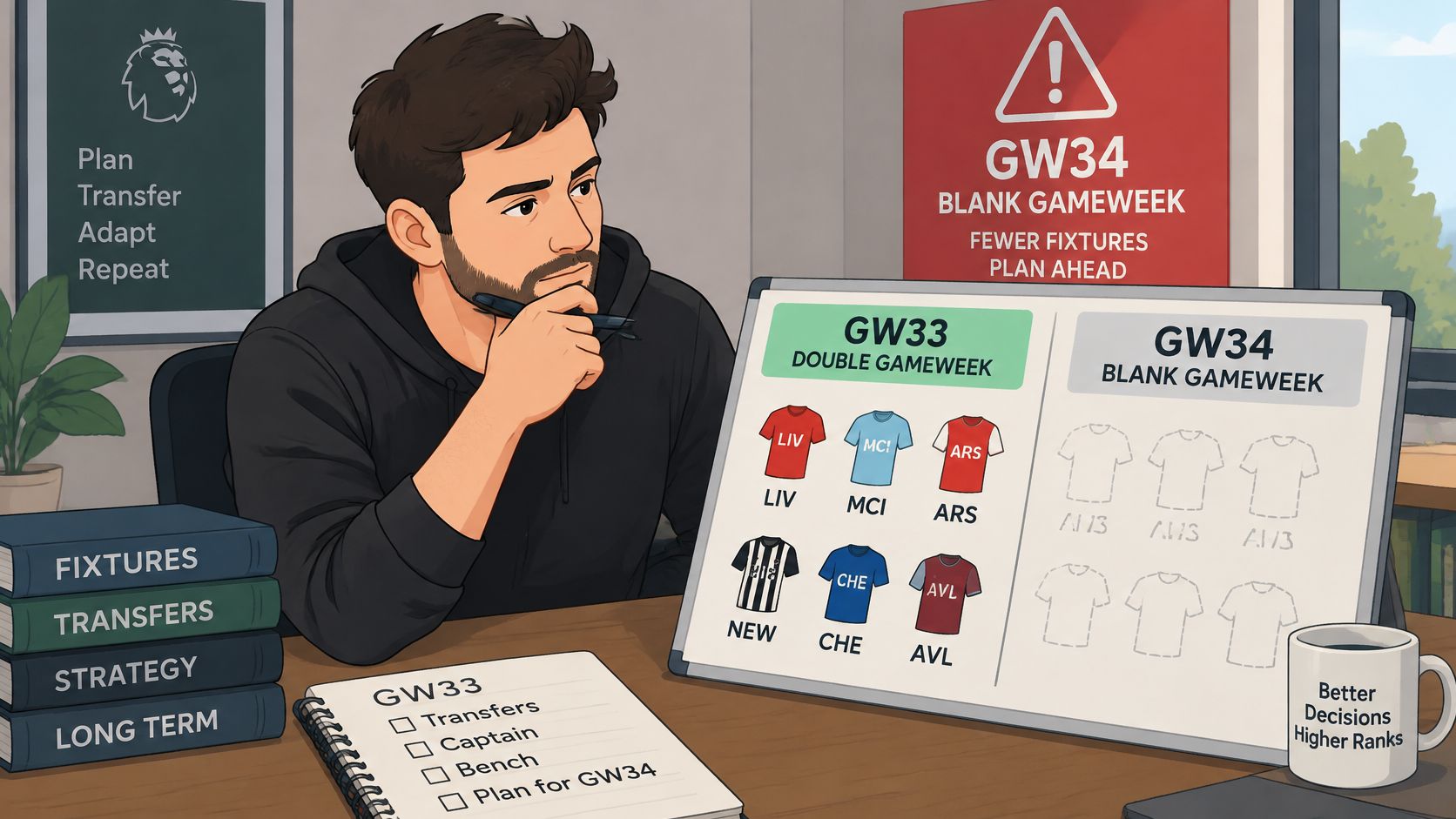
That player can offer two scoring chances and then a guaranteed zero, unless you hold a Free Hit, a strong bench or a planned exit. Fixture count does not measure the cost of the transfer. Our Free Hit guide is the chip side of that blank, not a reason to ignore it.
The three-deadline window
Model pre-double, double and the following blank, across two or three deadlines. For each name, record expected minutes, price, role, captaincy suitability and replacement cost.
Fixtures can still be removed or moved because of domestic and European cup commitments, and the final structure depends on those outcomes. Confirmed and provisional are different states. The useful question is which double assets stay useful across the next deadlines, and which need a planned sale.
Selling before a blank uses a transfer. With no free transfer left, it can cost a hit. Price that carefully. Each move beyond your free transfers carries a points deduction, so compare that cost with the gain you expect from the replacement across the double and the blank, and confirm the current deduction on the official FPL rules page.
Keep a double asset only if he remains useful after the blank. Otherwise plan the exit before the double, not after it.
The 2025/26 pattern shows the sequence. The 2026/27 structure has to be read from the official fixture list.
List which of your players blanks next. For each one, decide keep, plan a sell, or use a chip.
Confirm Your Double Gameweek Plan Before the Deadline
A Double Gameweek transfer is confirmed only when it survives the points-hit test. For any move beyond a free transfer, the gain from the incoming player's expected minutes across both fixtures has to outweigh the deduction and the cost of the blank that follows. If that edge disappears under a conservative minutes view, do not pay for the move. When the second fixture is still provisional, the same hit buys less certainty, so the threshold should rise rather than fall.
A passing answer is specific: the added starts justify the deduction now, and the squad can absorb the player's blank without another forced move. A failing answer usually relies on the badge, the presence of two fixtures or a projected score for one Gameweek while ignoring the blank after them. Fixture count creates the opportunity. Minutes determine whether that opportunity can repay the transfer.
What is public, and what is not
Every individual player profile is free, along with the Differential Picks, Budget Picks and Form Plus Next Fixture maps. The differential map compares eligible players' official next-Gameweek xP with current ownership, so it can inform the immediate transfer choice but does not project the full double-and-blank sequence by itself. Position, price, minutes and availability filters can remove players who do not fit the squad decision.
The other 14 maps and nine FPL tools are available to paid TFA members. Player prices, points, ownership and expected statistics come from official FPL data. A profile remains a reference rather than a team sheet, so use it to test role and minutes rather than treating a projection as confirmation.
Once a transfer clears the test, record the capture date beside the decision and the minutes assumption behind it. Review both after the Gameweek. That separates a reasonable process from a result that went badly.