FPL Bonus Points Explained: How the BPS Ranking Works

Don't buy a player because he collected 3 bonus points last week.
That's the most common mistake with FPL bonus points, and it's usually backward.
Bonus isn't a payment for a goal, assist or clean sheet.
It's a rank-based prize for finishing first, second or third in one match's Bonus Points System.
A player can return and get nothing extra.
Another can blank in raw FPL terms and still take bonus.
If you're deciding a transfer, captain or bench call, judge the route first.
Ask whether his minutes, role and repeatable actions can place him in the top three again.
Ask which season and ruleset produced the evidence you're using.
If you can't answer both, the safer judgement is hold, not buy.
How FPL Bonus Points Are Awarded After Each Match
After each completed Premier League match, the three highest BPS scores receive 3, 2 and 1 bonus points on top of any goal, assist or clean-sheet points.
The official Fantasy Premier League rules state that the Bonus Points System converts match actions into a performance score using statistics supplied by Opta, with 3 points for first place, 2 for second and 1 for third.
That ranking is match-specific.
A player's season standing has no bearing on one match.
He competes only against the other players in that fixture.
That's why a player can earn bonus without scoring or assisting.
His all-round BPS total only needs to finish high enough in that match.
It's also why a strong performance can still earn nothing.
Three better BPS totals in the same match remove him from the places.
Reading the Tie Rules
Ties change the allocation, so the bonus pool isn't fixed at three players every time.
Read the table row by row before you assume a player has lost bonus on a tiebreak.
There's no secondary tiebreak to guess at.
Equal BPS scores share the relevant position under the stated pattern.
Situation | Players rewarded | Points awarded |
|---|---|---|
No tie | 3 | 3, 2, 1 |
Tie for first | 3 | 3, 3, 1 |
Tie for second | 3 | 3, 2, 2 |
Tie for third | 4 | 3, 2, 1, 1 |
With no tie, three players receive 3, 2 and 1.
With a tie for first, both leaders receive 3 and the next-ranked player receives 1.
No player receives 2 in that scenario.
With a tie for second, the leader receives 3 and both tied players receive 2.
With a tie for third, four players are rewarded in total.
The leader receives 3, second receives 2, and both third-placed players receive 1.
Practical rule: Predict bonus from the final rank and any tie, not from who scored the goal.
What to Check After Full Time
Open the official BPS breakdown for the completed match before judging the outcome.
Check the top four scores, not only your player's total.
A one-point gap to third is a near miss, while a large gap shows the route wasn't close.
This explanation uses the rules publication recorded on 23 October 2026.
That date must be rechecked against the official rules page before publication, because the current date for this draft context is 2 November 2026.
Don't carry a verified rule from one publication window into another season without confirming it still applies.
Which Actions Build a Player's BPS Score
Start with minutes, because appearance sets the floor for every bonus route.
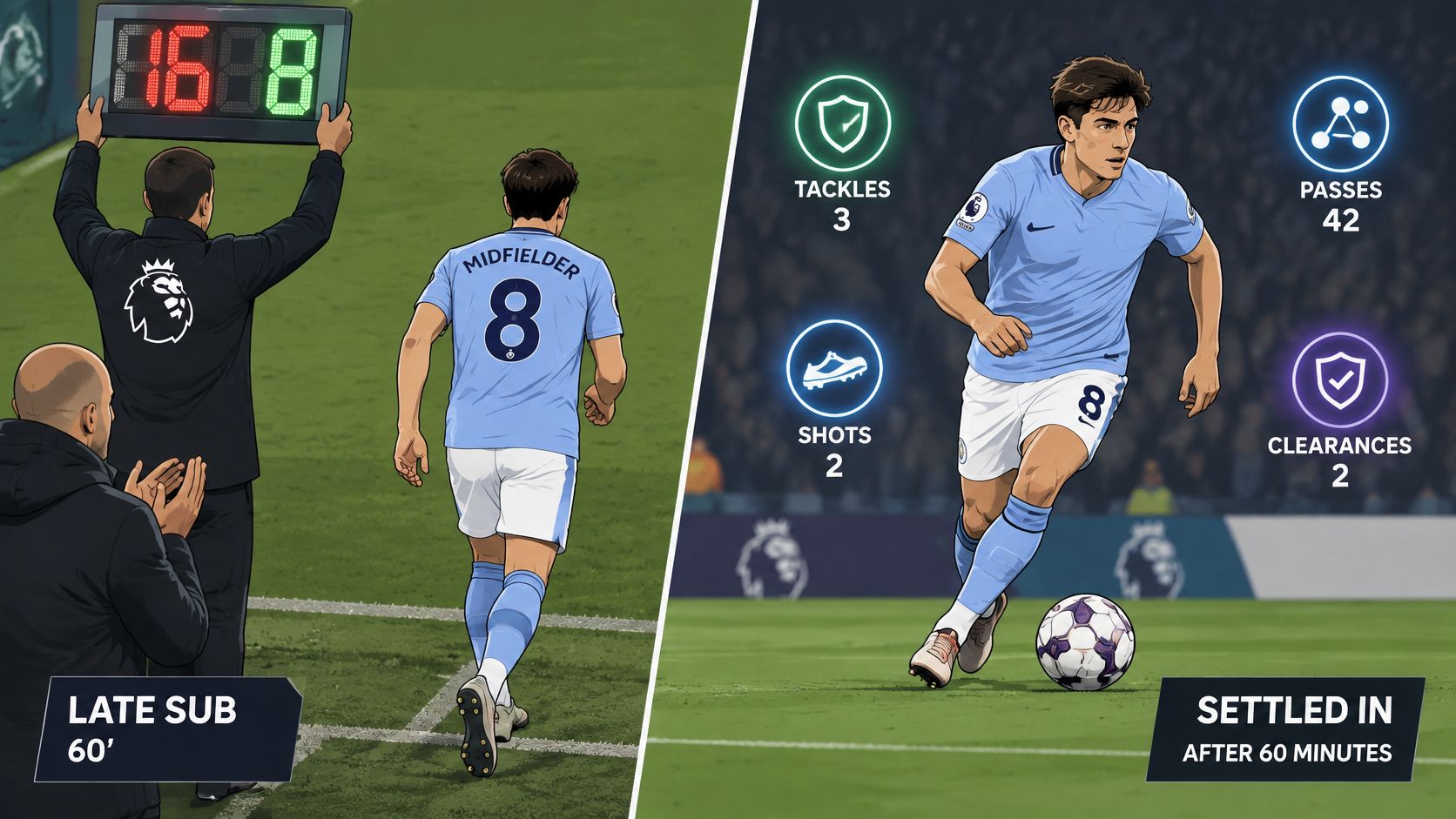
The official BPS scoring table on the Fantasy Premier League fixtures pages awards 3 BPS for playing between one and 60 minutes and 6 BPS for playing more than 60 minutes.
A late substitute therefore starts behind a secure starter before involvement is counted.
He needs exceptional output in limited time to catch players with the higher appearance base.
That's a transfer risk, not a minor detail.
Action | BPS value |
|---|---|
Playing 1-60 minutes | 3 |
Playing more than 60 minutes | 6 |
Assist | 9 |
Goal by goalkeeper or defender | 12 |
Goal by midfielder | 18 |
Goal by forward | 24 |
An assist gives 9 BPS.
A goal by a goalkeeper or defender gives 12 BPS.
A midfielder goal gives 18 BPS.
A forward goal gives 24 BPS.
Those figures explain why position changes the route.
A forward gets the largest single BPS award for scoring, yet he may offer less passing or defensive volume than a midfielder.
A defender gets less for a goal, yet he can add clearances, blocks, interceptions and tackles in the same match.
The Repeatable Layer
Key passes, successful tackles, clearances, blocks, interceptions and recoveries also contribute.
Individual values are smaller, but they accumulate through role.
Negative events reduce the total, so a scorer doesn't keep every point his goal appears to create.
Our research on defensive contributions is relevant here because defensive actions can be part of a repeatable bonus route rather than a one-off return.
Say a forward plays 75 minutes and scores once.
He has at least 30 BPS from those two inputs, 6 for minutes plus 24 for the goal, before any other action is counted.
That is a worked starting point, not a final score.
Other actions and deductions still move the total, and three opponents may still finish above him.
These BPS values are completed-match scoring inputs, not guaranteed FPL points and not forecasts.
Before buying a player for one goal, check whether his normal role supplies minutes above 60 and actions he can repeat.
Why Attacking Returns Can Still Miss Bonus
A midfielder scores, celebrates, and then watches a defender with no goal involvement take the bonus.
That outcome feels wrong if you treat bonus as a reward for the goal.
It makes sense once you treat it as a ranking.
The official Fantasy Premier League FAQs describe a composite system that ranks the top three players in each match and awards 3, 2 and 1 points respectively, while also rewarding minutes, passing accuracy, shots on target, big chances created and defensive work.
The defender may have played longer.
He may have passed more accurately.
He may have added tackles, clearances, blocks, interceptions and recoveries across the full match.
The midfielder's goal is one major input, not the whole score.
Missed big chances, errors and being tackled can also reduce his BPS under the model described there.
The reverse case is equally normal.
A goalkeeper or defender can enter the bonus places without an attacking return if saving, passing and defensive actions build a top-three total.
A Four Step Diagnosis
Use the same sequence after any confusing bonus result.
Read the full breakdown: Open the completed match BPS list, not only your player's profile.
Measure the margin: Identify the third and fourth scores and check how close the cut line was.
Separate the route: Split repeatable involvement, such as minutes, shots on target, passing and defensive actions, from one-off events like a single goal.
Test dependence: Ask whether the player needed one component to reach the places.
Our guide to FPL attacking stats helps you judge the attacking side of that route without treating a return as proof of bonus potential.
A narrow miss built on repeatable involvement is better evidence than a maximum bonus haul built on one event.
A single haul driven by one component is weak evidence for a purchase.
Judge the margin and route before you judge the bonus total.
Comparing Bonus Totals Across Rule Changes
Don't use a prior-season bonus rate as a current buying signal without checking the ruleset.
That comparison can point you toward the wrong player for a simple reason.
The actions behind the rank may no longer be valued the same way.
The Premier League summary of 2025/26 Fantasy changes to the Bonus Points System records that, for 2025/26, tackle wins received 2 BPS, goal-line clearances rose from 3 to 9 BPS, penalty goals received 12 BPS regardless of position, and goalkeeper shot-location scoring was revised.
For 2026/27, announced changes include goalkeeper rewards based on shot location and big-chance saves, penalty-save BPS falling from 8 to 7, and clearances, blocks and interceptions changing from one point per two actions to one per three.
Rule element | 2025/26 | 2026/27 |
|---|---|---|
Tackle wins | 2 BPS | To be verified against official rules |
Goal-line clearances | 9 BPS (up from 3) | To be verified against official rules |
Penalty goals | 12 BPS regardless of position | To be verified against official rules |
Penalty saves | 8 BPS | 7 BPS |
Clearances, blocks and interceptions | 1 point per 2 actions | 1 point per 3 actions |
Goalkeeper shot-location scoring | Revised | Rewards based on shot location and big-chance saves |
Do not infer the three unverified 2026/27 values from the 2025/26 column.
Mark them for confirmation against the official rules before using them in a player judgement.
Do not name a player group as a winner or loser from an unverified cell.
A verified change can still shift value between routes.
Reducing the return from clearances, blocks and interceptions weakens that specific route relative to its previous value.
Changing goalkeeper scoring alters how a goalkeeper reaches the rank.
Neither point tells you a named player will gain without match evidence under the new model.
Making a Fair Comparison
Label every sample by season, gameweek window and ruleset.
Compare bonus points per 90 minutes only inside a comparable ruleset.
Compare BPS rank share, which shows how often a player reaches the bonus places when he plays.
Compare the route, whether attacking, passing, goalkeeping or defensive, because rule changes affect routes unevenly.
Keep completed-match bonus data separate from refreshed market data.
They answer different questions and shouldn't be blended into one sample.
A bonus route supports a buy, hold or sell only when you can state which ruleset produced the evidence.
Checks to Run Before the Gameweek Deadline
Run these checks in order before you use bonus potential to justify a transfer, captain or points hit.
The Pre-Deadline Sequence
Confirm identity and price: Verify the player's current club, price and FPL position in official Fantasy Premier League data.
Check availability: Review any chance-of-playing flag, but don't read it as a guaranteed start.
Review recent minutes: Check the last several matches and ask whether playing more than 60 minutes is realistic.
Check fixtures and deadline: Confirm the next fixtures and the official deadline time before planning around them.
Price the hit: Weigh any points hit against the plausible bonus gain across the relevant fixtures, not the player's single best match.
Label the evidence: State the season, gameweek window and data capture date for every figure you use.
Player prices, points, ownership, form, transfers and expected statistics come from the official Fantasy Premier League data.
That source helps you verify the player in front of you, but it doesn't remove selection uncertainty.
A player can be available and still start on the bench.
A player can start and still be removed before the higher minutes input becomes secure.
Position, price, minutes and availability filters can remove players who do not fit a squad decision.
Use those filters early, because a strong bonus route is irrelevant if the player blocks a needed position or breaks your budget.
Official expected points cover the next gameweek only.
Don't read that value as a multi-gameweek bonus forecast.
Expected goals and expected assists show chance involvement.
They don't guarantee a return, a top-three BPS rank or bonus.
Keep season totals separate from recent-form samples.
Mixing windows can hide a role change, an injury return or a drop in minutes.
If a check fails, downgrade the bonus argument rather than explaining the failure away.
A fringe starter doesn't become a secure bonus pick because his last completed match went well.
Buying, Holding or Selling for Bonus Potential
Separate buying from holding, because the cost and evidence threshold aren't the same.
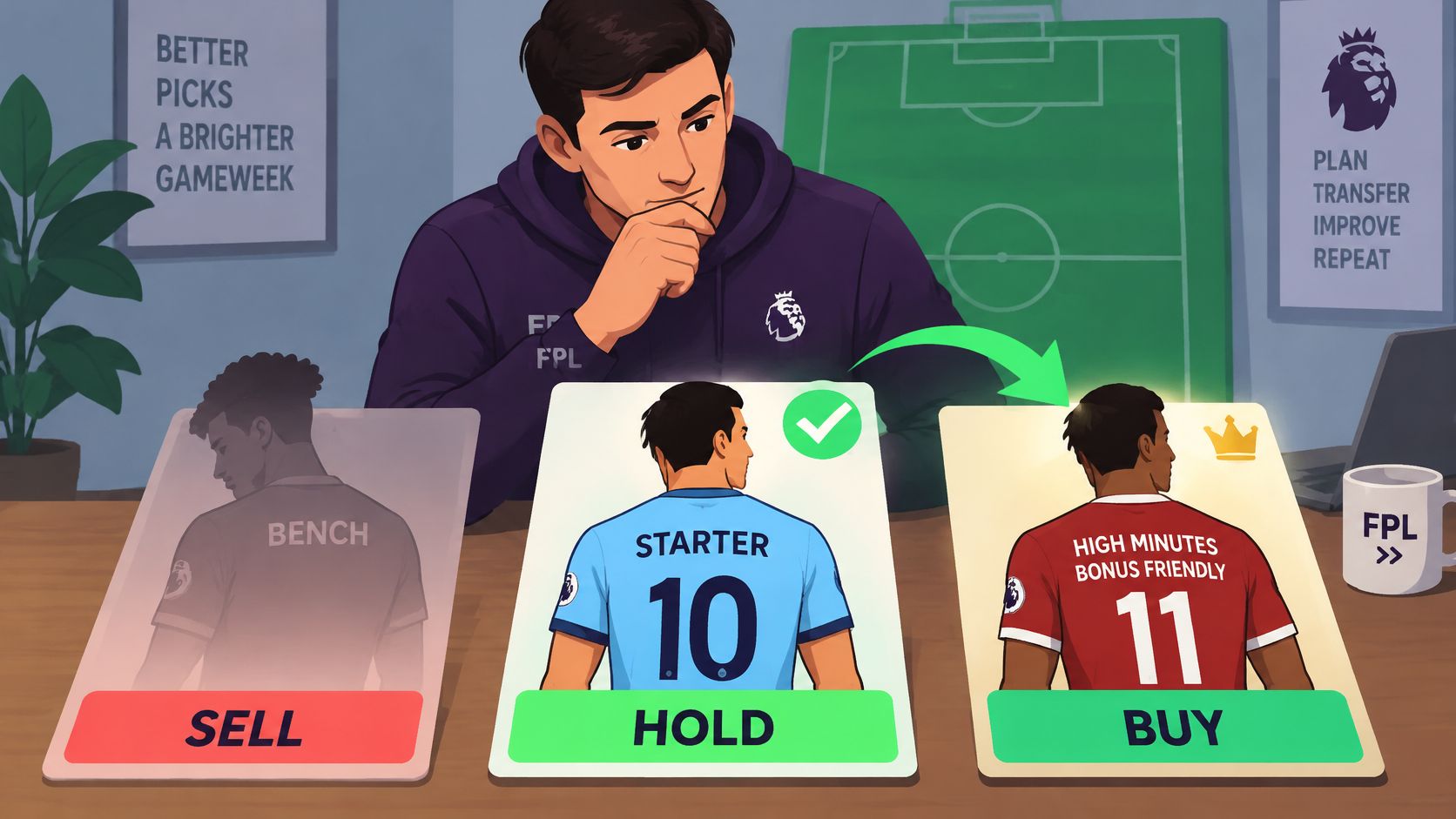
A buy uses a transfer, budget and sometimes a points hit.
It needs a repeatable route inside the current ruleset.
Look for a secure starter who normally plays more than 60 minutes.
Look for role-based actions beyond hoping for a goal.
Confirm the price fits without leaving a weak starter elsewhere.
Check the fixtures over the period you plan to own him.
Our latest FPL transfer trends can show market movement, but popularity isn't a substitute for checking his own BPS route.
A hold needs less new evidence.
If you already own a starter with a clear role, one poor bonus match isn't a sell signal by itself.
Check whether he still reached the minutes base.
Check whether his usual actions were present but three players ranked higher.
Check any injury flag carefully, because availability still doesn't guarantee a start.
If the role and minutes remain intact, holding is often more defensible than spending a transfer chasing last week's bonus winner.
A sell becomes stronger when the route itself has gone.
Rotation has cut his minutes.
A long absence removes the appearance base.
A poor fixture run lowers the chance of reaching the top three often enough.
His price now funds a clearer upgrade elsewhere.
Don't sell only because he finished fourth once.
Do sell when the reasons you bought him no longer exist.
Using the Ceiling Without Copying It
The Premier League review of FPL records from 2024/25 reported on 28 May 2025 that Mohamed Salah scored 55 FPL bonus points in 2024/25, a record for a single Fantasy Premier League season.
Use that total as a ceiling for a dominant attacking role.
Don't use it as a floor or forecast for another player.
A points hit needs more than admiration for that ceiling.
It needs a credible route across your planned ownership window, after the hit cost is counted.
Differential Picks, Budget Picks and Form Plus Next Fixture are free, along with every individual player profile, while the other 14 maps and nine FPL tools are available to paid TFA members.
Before you confirm the move, open the player's latest completed-match BPS breakdown on FPL Player Stats, check his rank, margin and route under the current ruleset, and only buy, hold or sell when that route supports the decision.