
Fantasy Football Points: How Scoring Shapes Player Value

There's one free transfer left before the deadline and two names sit at the top of the shortlist at the same price. One is a £6.0m defender in a side that keeps clean sheets; the other is a £6.0m forward in a side that doesn't.
If the job is a dependable floor across the next three gameweeks, take the defender. If the job is captaincy upside in one kind fixture, the forward is defensible, because his ceiling is a genuine haul rather than a steady eight.
Treat both £6.0m prices as illustrative until you've checked them against current official FPL data, and answer the question first: which of the two finds points when he plays badly?
The Points System Behind Every FPL Decision
A player can score through goals, assists, clean sheets, minutes and defensive work. The useful question is how many routes a role has to points in an average week, and how reliably those routes recur against the next opponent.
Each rule shapes both a player's floor and ceiling. Position and minutes determine which awards are available, while the scoring system determines how much each route contributes to a gameweek total.
The rulebook is the first analytical tool
Since 2025/26, defensive-contribution thresholds have added routes to points. A total from 2023/24 therefore reflects a different scoring system from a current total. Treating those numbers as directly comparable can lead to a mistaken transfer call.
A season total records the routes a player has already hit. It does not guarantee those routes will recur. Before buying, holding or selling, identify what produced the points and whether the upcoming fixture offers similar opportunities.
What you'll be able to do by the end
Take a gameweek score, identify its contributing routes and judge whether they are likely to recur against the next opponent. Then use that assessment to make a buy, hold or sell decision, or choose the armband.
Scope check: 2026/27 season, target Gameweek 11, official scoring rules verified on 22 October 2026, statistical window of completed 2026/27 matches to that date. Price and availability move after the window closes, so re-check both at the deadline.
How FPL Points Are Awarded
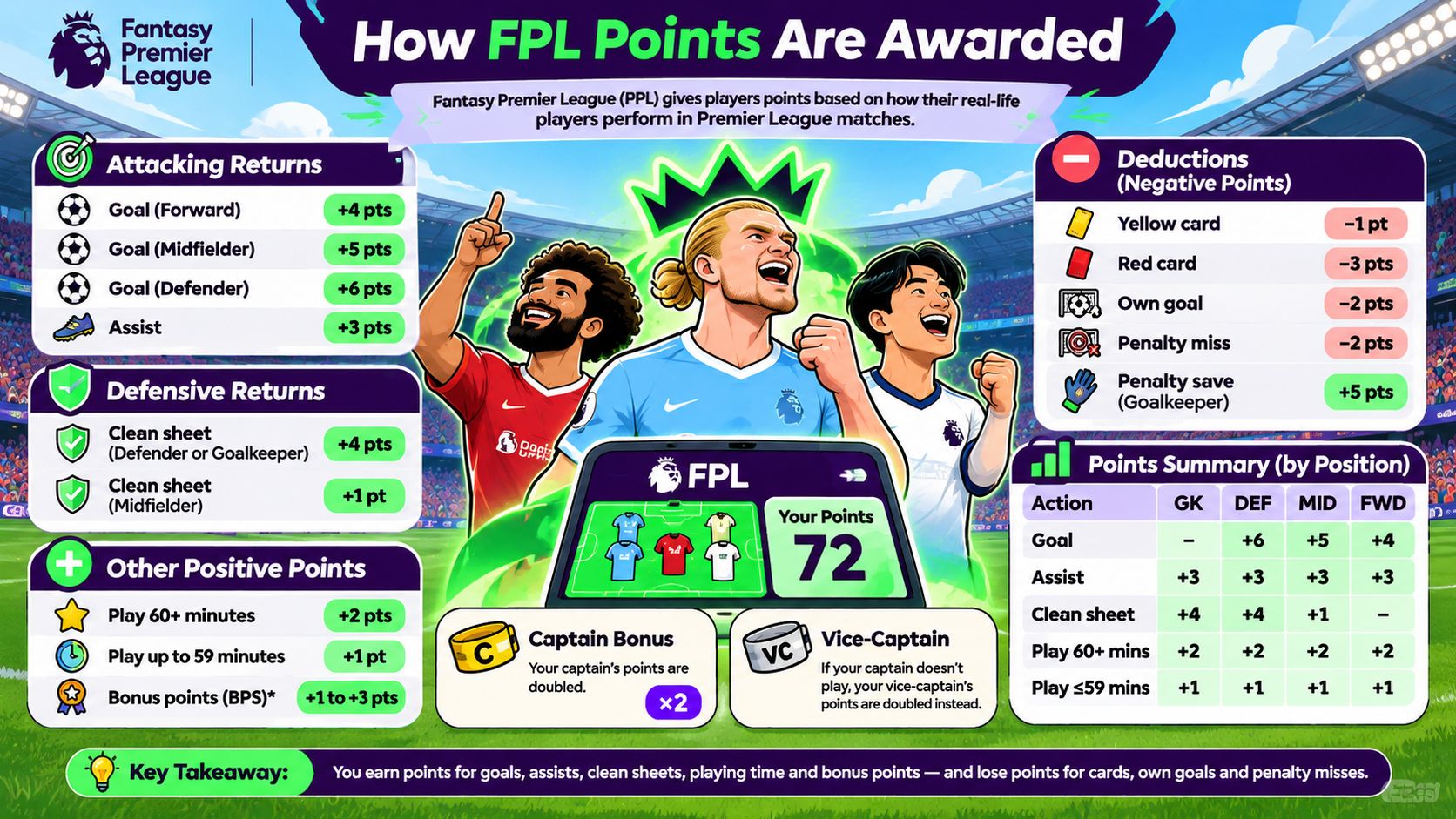
The values below come from the official scoring rules page, verified on 22 October 2026, and the map is complete. If an action isn't listed, it doesn't move a score (official FPL rules).
Here's the shape of the system before the detail.
Minutes are paid before anything else
1 point for appearing for up to 60 minutes.
2 points for playing at least 60 minutes, excluding stoppage time.
That's the smallest award on the page and the one everything else depends on. A player withdrawn on the hour still collects the full amount, while a substitute introduced at 70 minutes collects half of it.
Goals carry a position weighting
Goalkeeper goal: 10 points.
Defender goal: 6 points.
Midfielder goal: 5 points.
Forward goal: 4 points.
Assist, any position: 3 points.
A defender's goal is worth half again as much as a forward's. That single line explains most of the pricing gap between an attacking full-back and a mid-table striker, and goalkeepers get the richest rate of all for a rarity that occasionally happens.
Clean sheets, saves and defensive work
Clean sheet, goalkeeper or defender: 4 points.
Clean sheet, midfielder: 1 point.
Goalkeeper saves: 1 point for every 3.
Penalty save: 5 points.
Defensive contribution, defender: 2 points for reaching 10 combined clearances, blocked shots, interceptions and tackles.
Defensive contribution, midfielder or forward: 2 points for reaching 12 combined defensive actions, with recoveries included for those positions.
Clean sheets are the only award on this list that pays a defender more than a midfielder, and forwards get nothing from them at all.
Bonus and the deductions
Bonus points: 1 to 3 for the best performers in a match.
Missed penalty: minus 2.
Yellow card: minus 1.
Red card: minus 3.
Own goal: minus 2.
Goals conceded: minus 1 for every 2 conceded, for a goalkeeper or defender.
Practical rule: judge a player by how many of these lines he can hit in an ordinary match, not by his best match of the season.
Read the list again and it splits into two halves. Floor points come from minutes, clean sheets and defensive work, and they arrive whether or not the player touches the ball in the box. Ceiling points come from goals, assists, saves and bonus, and they arrive in bursts.
A player worth his price has a plausible route to both. A player with only a ceiling needs the good week to justify the fee, and that's exactly the risk the £6.0m forward in the opening example carries.
How Position and Defensive Contribution Shape Player Value
A defender and a forward can both score, but the defender earns six points for the goal and the forward earns four. Add a clean sheet and the defender gains four more, while the forward gains none. That difference matters when two players cost the same.
The same event, priced by position
Position weightings give the same contribution different values. Goals are worth 6 points to a defender, 5 to a midfielder and 4 to a forward under the official scoring rules. A clean sheet is worth 4 to a goalkeeper or defender, 1 to a midfielder and nothing to a forward.
An attacking defender can score through both goals and clean sheets. A forward relies on attacking returns for those points, so compare their likely routes to points before choosing between similarly priced players.
A threshold that pays for work without the ball
The 2025/26 scoring redesign added a defensive-contribution award. Defenders receive 2 points after reaching 10 combined clearances, blocks, interceptions and tackles in a match. Midfielders and forwards need 12 combined defensive actions, with recoveries included.
The reward arrives at the threshold: a defender's 11th qualifying action does not add a point, but reaching 10 actions awards 2 points for the match. A player who averages eight actions and often reaches 10 can be a better pick than one whose average is slightly higher but who crosses the line less often.
Practical rule: judge a player by how often he reaches the threshold, not just his average.
Read threshold-hit rates and ignore the smoothing
Averages can hide whether a player crosses the line in an individual match. Role offers a useful clue. A centre-back in a side that defends deep may reach 10 through clearances, blocks, interceptions and tackles. A ball-winning midfielder may reach 12 more readily than a possession midfielder who circulates passes.
Minutes matter too. A rotation player who plays 55 minutes has less time to build defensive actions and misses the second appearance payment. That makes the threshold award less dependable for him.
Fixture and game state affect action volume. A team protecting a lead may record more clearances and blocks; a dominant side may keep the ball and pursue a clean sheet instead. The defensive-contribution research page lets managers compare how often eligible players reach the threshold, a detail per-90 averages can obscure.
Past threshold frequency describes a player's involvement in those actions, not a guarantee of points next match. Check whether the upcoming opponent and likely game state suit the role.
The goalkeeper case sits on the same logic
A goalkeeper's points depend partly on the team in front of him. One behind a busy defence can collect saves at 1 point per 3 saves. One behind a dominant defence may get clean-sheet points but make fewer saves.
These profiles carry different risks. A fixture that improves clean-sheet prospects may also reduce the goalkeeper's chances to earn save points.
Why the rule change breaks straight comparisons
The revised assist rules would have produced 41 additional Fantasy assists in the previous season, according to the Premier League's explanation of the 2025/26 scoring changes. A change in definition changes the totals, so historical scores from different rules eras are not directly comparable.
Check which rules applied before using past points totals to rank players. Otherwise, a change in scoring can look like a change in player value.
Where the value usually sits
Managers who rank defenders and midfielders by attacking returns alone can overlook players with points routes through clean sheets or defensive contributions. An attacking defender in a competent side may combine appearance points, clean-sheet points, the defensive award, a goal and bonus in one match.
A forward at the same price needs attacking returns to build a comparable score. Compare the routes each player offers, then buy the one whose likely role best fits your squad.
Turning Match Events Into FPL Points
The rules only become instinct when you run a real match through them. Four examples, taken in order of how often they decide a mini-league.
A defender's complete gameweek
Ninety minutes, a clean sheet, a goal, 10 qualifying defensive actions, second place in the bonus rankings.
Appearance, 60 minutes or more: 2
Clean sheet: 4
Defender's goal: 6
Defensive contribution: 2
Bonus for second in the match: 2
Total: 16
The lesson isn't the 16. It's that no single route in that list is unusual, and what produced the score was four of them arriving together, which is what a good defensive side with a threat from set pieces does more often than a purely defensive one.
A booked midfielder's nine
Seventy minutes, a goal, an assist, a yellow card.
2 + 5 + 3 - 1 = 9 before bonus.
The lesson is that the booking cost him a full point, and it's the cheapest deduction on the list. A player who collects cards regularly pays for them across a season, and that cost never appears in a highlight reel.
A forward's modest four
Seventy-five minutes, a missed penalty, a goal later in the match.
2 + 4 - 2 = 4.
The lesson is that a headline goal can hide a poor return. A striker who takes penalties will miss some, and the two-point deduction wipes out most of the appearance and bonus value he built earlier. Judge from the scoreline in the app, not from the match report.
A goalkeeper's twelve
Ninety minutes, five saves, a penalty save, a clean sheet.
2 + 1 + 5 + 4 = 12, because saves pay 1 point for every 3 and five saves is a single point.
The lesson is that save points are a trickle, not a stream. The clean sheet and the penalty save did the heavy lifting, and the five saves added one point to a double-digit score.
The habit worth building
Before every deadline, take the player you're closest to buying and list the routes that produced his last score. Then ask whether the role makes each of those routes repeatable against the next opponent.
If the list is one line long, you're buying a ceiling with no floor.
Captaincy, Minutes and the Points You Bank
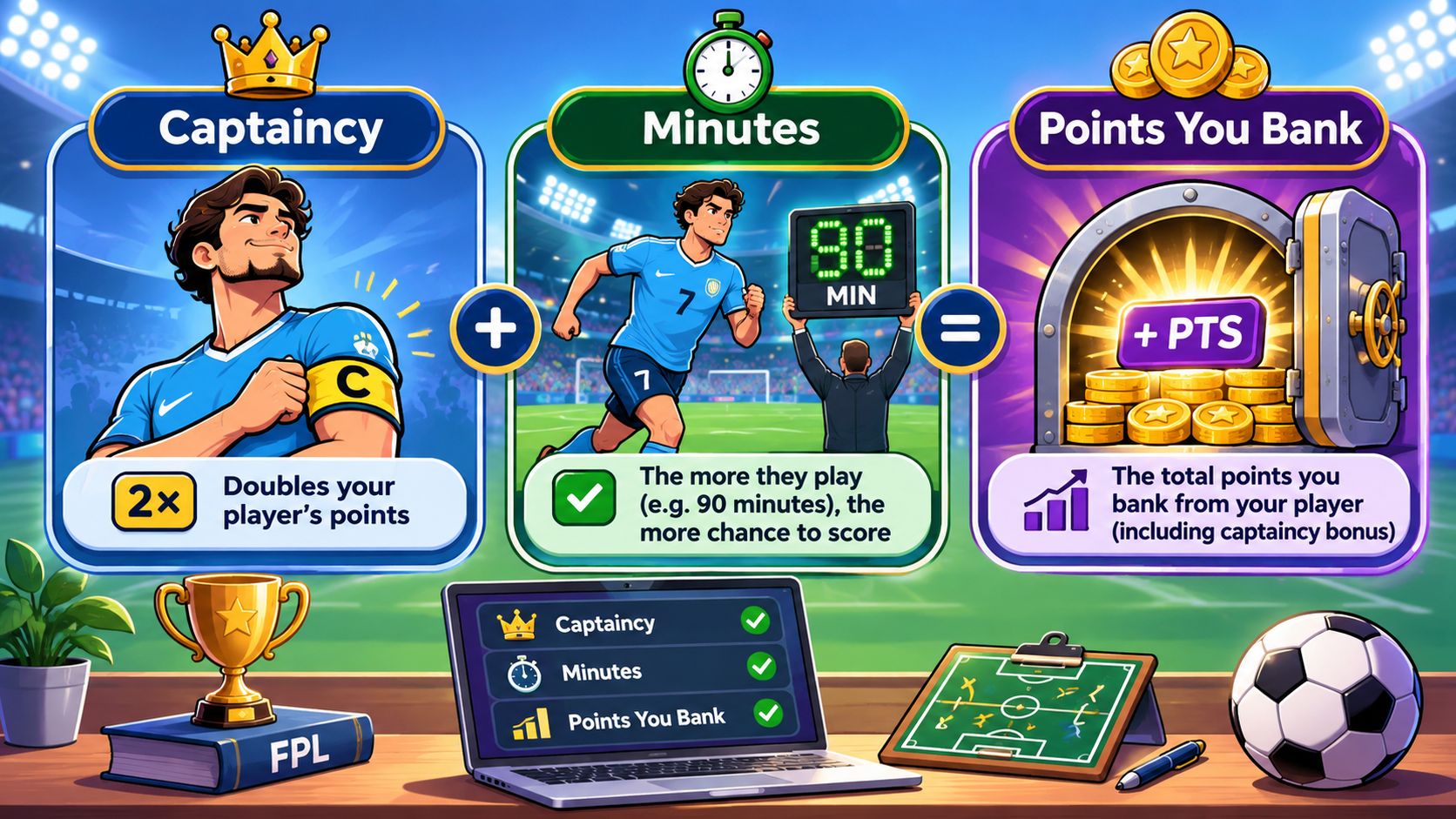
The armband is the biggest single decision of the week and the one where minutes risk costs most, because the multiplier applies to whatever the player banks, including a two-point cameo.
Keep that in mind before the armband gets attached to the best player in the game rather than the safest one in your squad.
The multiplier does the work
Under the official game help, the captain's score is doubled while only 11 of a 15-player squad score in each Gameweek, with the remaining four benched. Twelve points from a captain is a good week. Two points from a captain is a hole you spend the rest of the squad covering.
That's why the strong first substitute matters as much as the armband itself. A bench player who starts and plays 70 minutes protects you against the captain being rested, and against a late injury elsewhere in the eleven.
Minutes uncertainty suppresses every other route
An appearance that ends before the hour pays only the smaller appearance award, and a 20-minute cameo rarely collects clean-sheet, defensive-contribution or bonus points at all. The base score falls and the probability of every other award falls with it.
This is the mechanism most captaincy debates skip. A talented player with uncertain minutes isn't a slightly worse option than a reliable one; he's an option whose entire scoring profile is discounted.
Our minutes research page tracks which players are banking the full 90, which is the evidence a flag on its own can't give you.
The availability test before the deadline
The official player-news page lists injury probabilities and return information, including a player marked at a 75% chance of playing, another at 50%, and cases carrying an unknown return date (FPL player news). The same source's fixtures information puts the Gameweek 11 deadline at Saturday 21 November, 11:00.
A 75% flag is not a start. It's a probability attached to a decision you have to make before you see the lineup.
Judgement call: if a doubtful starter has no playable bench cover behind him, the armband belongs elsewhere regardless of fixture.
The call I'd make
Favour a reliable starter with several scoring routes over a similarly priced player whose role depends on late team news, unless penalties, set pieces or an exceptional fixture clearly compensate for the risk. That exception is real, but it needs to be specific, not a feeling about the fixture.
For an existing owner the calculus differs from a buyer's. An owned doubtful starter can often be held, because the replacement costs a transfer or a hit, whereas buying one creates a problem you didn't have. That trade-off belongs with the transfer decision rather than the captaincy one.
Transfer Hits and the Buy or Hold Decision
A hit is a points cost you pay before a ball is kicked, and the official help material confirms that transfer points are deducted from your total before the transfers are confirmed (FPL help and FAQs). The incoming player therefore has to recover the hit and then beat the player sold.
The break-even maths
A four-point hit requires the incoming player to deliver at least four additional points across your comparison period just to reach parity, before any future value or flexibility counts. That's the threshold to hold in your head, and the mistake is measuring it over one fixture.
Define the comparison window before you commit. Three gameweeks is a sensible frame for a role-based transfer, because it covers a fixture swing without pretending you can forecast a player's season.
Identical prices, different ceilings
Positional scoring changes what a hit buys you. A defender can clear four points through a clean sheet and a threshold hit without touching the ball in the box. A midfielder needs a goal or an assist to do the same, and carries only a token clean-sheet reward.
Same price, different distribution of returns. The defender recovers the hit through routes that don't need his team to dominate. The midfielder recovers it in one afternoon or not at all.
That difference should change your confidence, not just your projection.
When holding beats a hit
For an existing owner, holding is usually preferable when the replacement's expected gain is small and the hit would consume most of the improvement. A two-point-per-game upgrade that costs four points to acquire takes two gameweeks to break even and offers nothing if the new signing is rotated.
Holding also preserves flexibility, which is worth something in a season with injury uncertainty every week.
The planning test
A hit is easier to justify when the incoming player has a stable role across several gameweeks and the outgoing one has lost his. It's harder to justify as a one-week punt on a fixture, because the fixture is the least repeatable part of the equation.
More worked examples of that trade-off sit in our FPL transfer tips guide if you want the decision pattern rather than the theory.
Break-even rule: if the projected gain doesn't clear the hit inside your window, the transfer is a preference, not an upgrade.
Turn the Scoring Rules Into Your Next Transfer
A player can look like an obvious buy on recent returns yet offer only one dependable route to points. Before the deadline, test the move against these seven checks.
Map the scoring routes. Consider likely minutes, attacking returns, clean-sheet potential, defensive-contribution eligibility and possible deductions. A player reliant on goals has a different risk profile from one who can score through several routes.
Set the comparison window. Separate season totals from recent form, and specify the gameweek range you are assessing. A short sample and a season-long record answer different questions.
Check current circumstances. Confirm availability, upcoming fixtures and price using official FPL information. Any details checked earlier may have changed by the deadline.
Assess chance involvement. Expected goals, expected assists and xGI per 90 can show whether a player's involvement supports his returns. They describe underlying chances, not guaranteed future points.
Use expected points for the right window. Next-gameweek xP is the official expected-points value supplied by FPL, and FPL Player Stats uses it unchanged. It applies to one gameweek, not a run of fixtures.
Account for a points hit. Compare the projected gain with the deduction over your chosen window. The transfer needs to recover the cost within that period to improve your team.
Make a conditional call. Buy, hold or captain based on the role, minutes, form, fixtures, price and availability. Record the reason so you can judge later whether the decision matched the evidence.
Before the next deadline, run your target through all seven checks. If his only route to points is a goal and the move costs four points, weigh that narrow upside against the deduction before you commit.