Fantasy Football Bench or Start: How to Decide in 2026
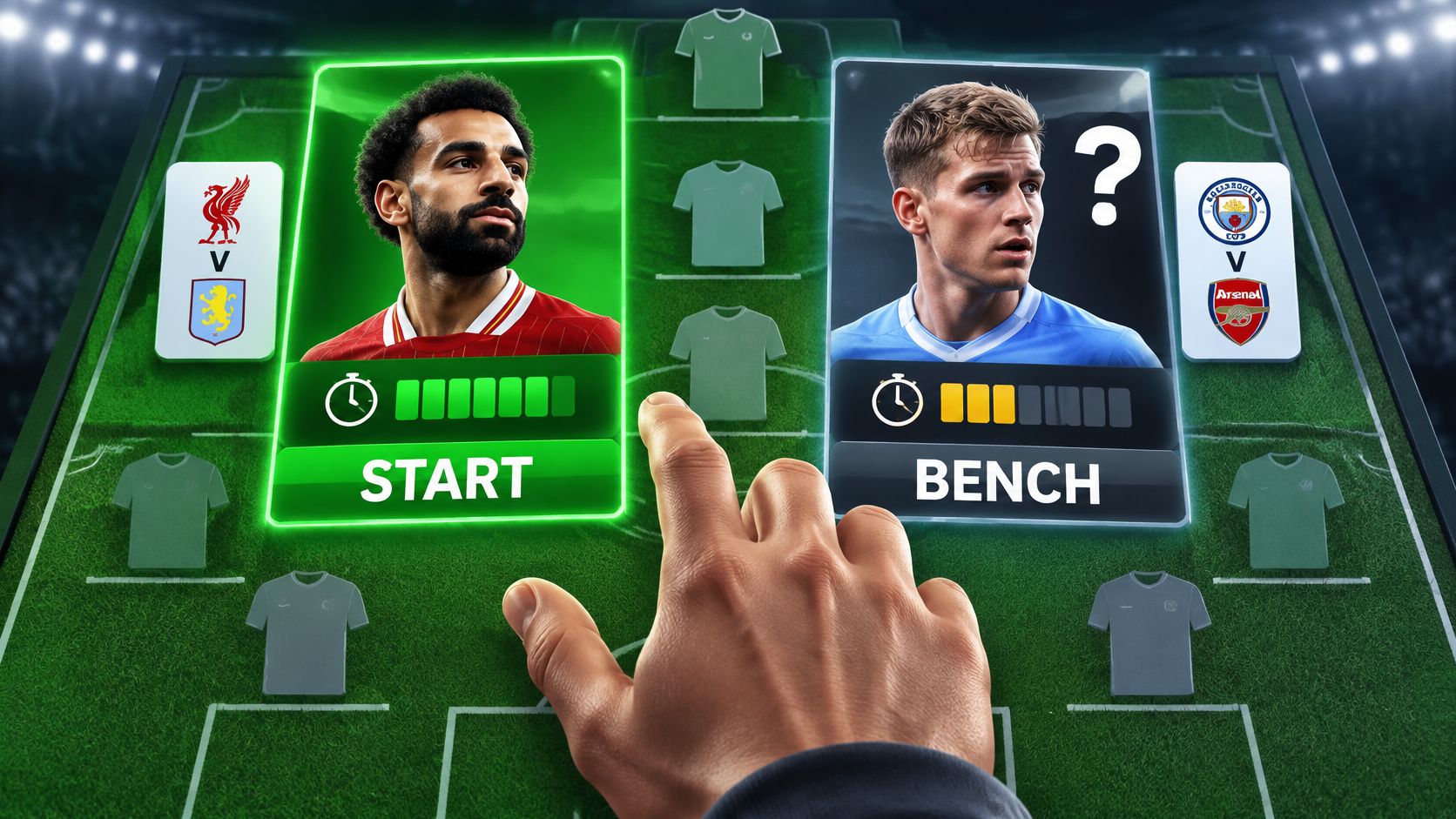
The clock is close to the deadline, and your last call is between two usable players. One has the softer matchup but might be rotated, benched, or managed after halftime. The other faces a tougher opponent and is still the safer bet to stay on the pitch for 80 to 90 minutes. In the 2026/27 season, that is the order of the decision: expected minutes first, fixture appeal second. A kind opponent does not turn a short cameo into a start, and a hard match is not a reason to bench a starter whose place is secure. Once the minutes are secure, form, role and fixture can separate the options.
The Starter and Bench Comparison at a Glance
Start the player whose probability of playing 60 or more minutes is clearly higher, unless the bench option offers a clearly larger attacking return and the starter's minutes are uncertain. For one target Gameweek in the 2026/27 season, you judge expected minutes, role, fixture context and availability. Whole-season totals do not settle a single call.
History shows how far season numbers sit from one bench decision. The Premier League account history records one account on 2,809 points in 2021/22, finishing ninth overall, a completed-season benchmark that says nothing about whether a named bench player should have started in a named Gameweek.
Starter and bench option compared by criterion
Criterion | Starter | Bench option | Why it matters |
|---|---|---|---|
Expected minutes | Confirmed or strongly indicated 60 to 90 minutes | Under 60 minutes, or uncertain role | Sets the appearance and clean-sheet floor |
Appearance points | 2 points for 60 or more minutes | 1 point for fewer than 60 minutes | Official scoring rule |
Clean-sheet eligibility | Available to defenders and goalkeepers at 60 or more minutes | Unavailable below 60 minutes | Matters most for defensive options |
Attacking involvement | Goals, assists and xGI per 90 over a stated window | Same metrics, weighed against likely minutes | Chance evidence only |
Fixture context | Next Gameweek opponent, venue and xGC | Same window, judged on the same basis | Compare within one window only |
Availability | Confirmed, or flagged but expected to play | Doubtful, unconfirmed or rotated | A flag does not guarantee a start |
Captain eligibility | Can be captained, with the score doubled | Cannot be captained while benched | Raises the cost of a wrong call |
Expected minutes, clean-sheet eligibility and availability decide most calls. Attacking involvement breaks a tie only after both players can realistically complete an appearance, and a strong per-90 line built on substitute cameos reads weaker than a modest line built on full matches. Fixture context stays inside one Gameweek, with opponent, venue and chance concession read on the same basis. Captain eligibility raises the cost because a benched player cannot carry the armband.
Practical rule: If you cannot defend 60 minutes for the player you want to start, the kinder fixture is not a reason on its own.
Three checks the table implies
Minutes. Ask whether a full appearance is likely before you read recent returns, because a cameo caps what any fixture can deliver.
Fixture context. Compare the next opponent inside one window, and treat a kind fixture as a lift to expectation that applies only once minutes are secure.
Availability. Treat a flag as a prompt to wait for confirmed team news, and treat rotation risk as a reason to move the player toward the bench side of the table.
What Happens When a Starter Does Not Play
Only the starting XI scores first. Under the official FPL rules, each lineup draws 11 starters from a 15-player squad with at least one goalkeeper, three defenders, two midfielders and one forward, and the Gameweek deadline falls normally 90 minutes before the first match. The last start-or-bench call therefore has to run on team news confirmed before that cutoff. Rules checked against the 2026/27 help pages on 28 October 2026.
If a starter records no appearance, the game replaces that player at the end of the Gameweek with the highest-priority eligible substitute who played. Formation rules limit who can enter. Start with three defenders and an absent defender can be replaced only by a defender, so a bench stacked with midfielders cannot rescue a missing full-back. Set bench order as a deliberate tactical choice: a reliable first substitute covers late injuries, rotation and unexpected omissions.
Any appearance blocks that switch, even a one-minute cameo. The original starter keeps the place and the bench player goes unused for points. Order the bench by expected minutes rather than fixture appeal: the player closest to a full 90 goes first at each position, and the four together should cover every position your likely formations need.
Substitution outcomes and what to check
Starter outcome | What the game does | What to check |
|---|---|---|
Starter plays any minutes, even briefly | Original starter keeps the place | Whether those minutes reached the appearance threshold |
Starter records no appearance | Highest-priority eligible substitute who played takes the place | Bench order and position coverage |
Absent defender | Replaced only by an eligible defender | A defender on the bench |
Substitute plays 59 minutes | 1 appearance point and no clean-sheet component | Whether a 60-minute role is realistic |
Formation changes the eligible options | Constraints limit which bench player can enter | The likely formation before the deadline |
How to order the four
First on the bench. Use the outfield player most likely to complete a full appearance if a starter is omitted, and match that player's position to the gap you fear.
Position cover. Keep a defender available when your formation already sits on three at the back.
Goalkeeper. A playing reserve returns points only when your starter does not appear at all.
The cameo trap. A risky starter still expected to come on will block the switch, because any minutes end it. Auto-sub pays out only on a complete no-show.
Expected Minutes Come Before Form
Treat the call as a minutes-probability problem before you compare form. The official FPL scoring rules award the second appearance point and clean-sheet eligibility only at 60 or more recorded minutes, stoppage time excluded, so the 59-minute cameo in the substitution table above falls short of both. Those rules set a floor, not a ranking of players.
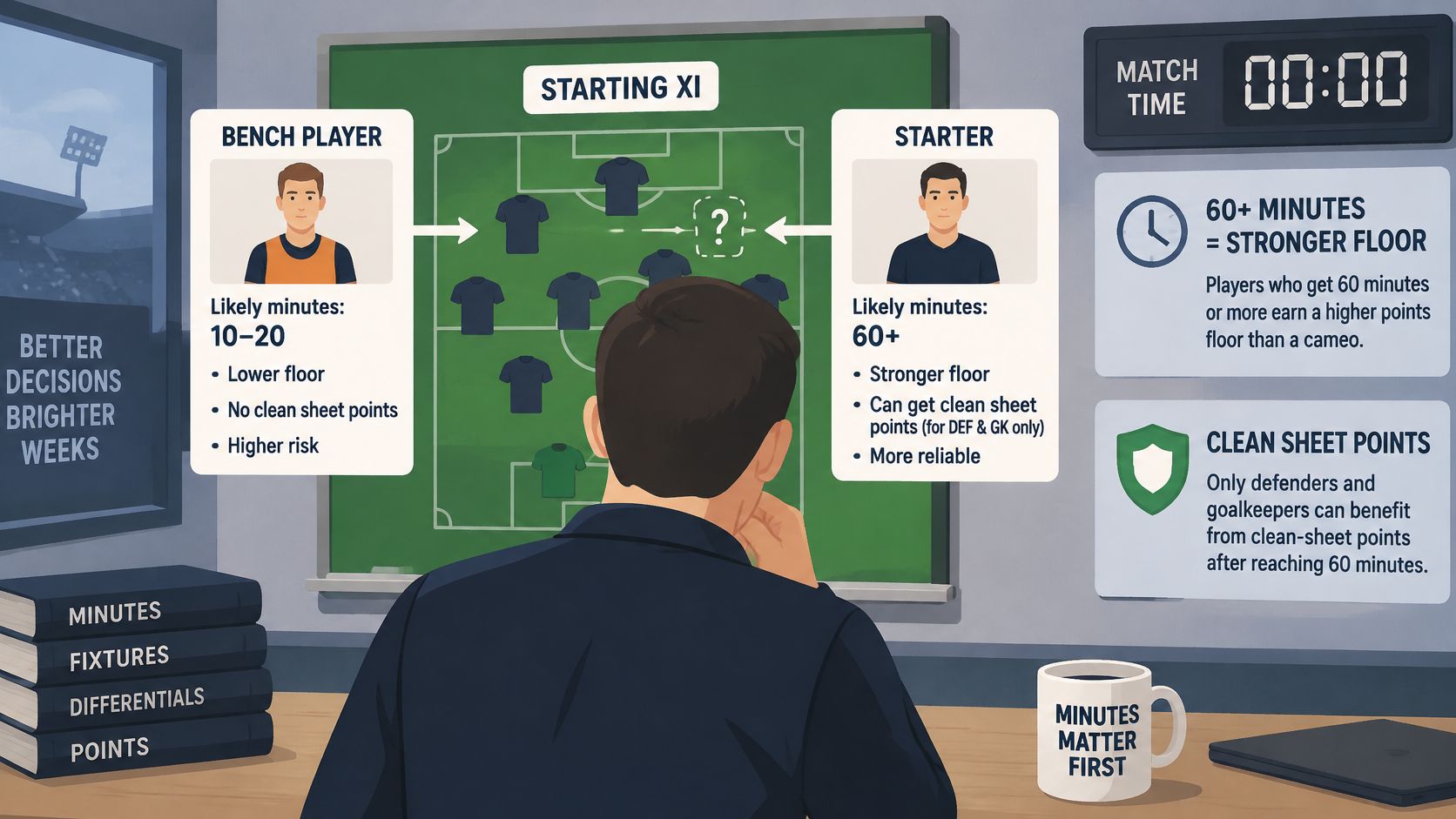
A defender or goalkeeper with a plausible 60-minute role carries a higher floor than a similarly ranked substitute who may fall short of the threshold. A rotation-risk attacker should displace that player only when the expected attacking return is large enough to offset the lost appearance points and the lost clean-sheet chance. The FPL Player Stats minutes research separates completed-match minutes from a guess about the next team sheet, which is the distinction this decision turns on.
A minutes worked example
Say a rotation-risk forward posts strong attacking numbers in one Gameweek, and the alternative is nailed for about 85 minutes with a lower ceiling. I would start the forward only if the expected involvement clearly outweighs the appearance floor you give up. If that gap is small, the nailed player starts, because a bench option who reaches the pitch keeps his place anyway through the auto-sub rules covered earlier.
A minutes checklist
Last five league matches. Count starts and note the minute of each substitution, since a player repeatedly withdrawn before the closing stages is a different risk from one who finishes matches.
Competition split. Separate league, cup and European minutes so a dead-rubber rest is not misread as a lost league role.
Early withdrawals. Mark matches ended by injury or by a planned hook, because those patterns repeat more often than a single scoreline suggests.
Manager history. Check how the manager used this player after midweek fixtures and international windows, not one odd team sheet after a heavy win.
Confidence falls when several of these sit on the same player. European involvement, international travel, a recent return from injury, and a squad with several options in the same role all lower the chance of 80 to 90 minutes. Position, price, minutes and availability filters can remove players who do not fit a squad decision before you compare the pair that remains.
Minutes come first, then attacking data, then fixtures.
Using Fixtures Once Minutes Are Secure
A good fixture earns its place in the decision only after the minutes question is answered. Generic advice to start the easier fixture often confuses a soft opponent with a likely 60-minute appearance, and the 2026/27 calendar shows why that confusion costs points. The Sports Gambling Podcast congestion analysis published on 14 September 2026 counts 38 rounds squeezed into 33 weekends and five midweek rounds, nine clubs facing a 125-day stretch of European football without a break, and a 16-day September to October international window in which countries played four matches rather than two, with rotation expected to rise across that schedule. Those figures describe a calendar window, not a live Gameweek. They explain why rotation risk exists; they do not name a team sheet.
The minutes-first rule still governs the call: a player near-certain for 80 to 90 minutes outranks a softer opponent with an uncertain place in the eleven. What a congested calendar adds is timing. A European away match on Thursday night leaves a short recovery window before a weekend league fixture, and that gap is where a nailed defender becomes a rotation candidate for one week only. Completed-match minutes and current availability are different records, and they should not be blended.
A labelled hypothetical
Two defenders face the same opponent in one Gameweek. One is nailed for about 85 minutes. The other was rotated after a midweek European match. The nailed player usually wins the call, even when a difficulty rating looks kinder for the rotated defender. Treat this as an illustration of the rule, not a real team sheet.
Read these inputs for a single Gameweek, and keep them inside that window.
Opponent record. Use the recent defensive sample you have dated, not a season-long blur.
Venue. Home and away change both selection habits and chance concession.
Likely rotation. Ask who played in midweek, and who travelled.
Matches before the next deadline. A short turnaround is a minutes problem before it is a fixture problem.
Fixture difficulty ratings and team-level expected goals against describe the opponent. They do not describe whether your player starts, takes set pieces, or leaves at the hour. List the fixtures for the next two Gameweeks on the fixtures research view, and mark any that follow midweek travel or a European match. Start a player only when a meaningful appearance is more likely than the upside you would gain by gambling on the softer fixture.
Reading Expected Points and Chance Data Correctly
Three kinds of evidence get mixed in public coverage, and they answer different questions. Official expected points are a next-Gameweek value. Historical expected goals, expected assists and derived xGI per 90 measure chance involvement over a stated season or window. Recent FPL points are an outcome, a third category entirely.
Round-ups that place official expected points, price and ownership side by side describe one Gameweek only. A player who leads that snapshot has not been shown to be the better start across the next three or four. The figure belongs to the week it was captured.
One academic dataset, the University of Vaasa analysis, gives a sense of scale for these relationships outside a live FPL model: four-Gameweek rolling form correlated with total points at about r = 0.19, expected goals at about r = 0.17, expected assists at about r = 0.15 and minutes played at about r = 0.11, while a five-Gameweek test scored 307 points for its data-driven selection against 299 for a recent-form heuristic, an eight-point gap inside that experiment only.
Correlations that weak are a warning against reading any single metric as a verdict. Underlying metrics identify opportunity. Minutes decide how often that opportunity can occur, so a high-xGI-per-90 player with uncertain starts does not displace a reliable 80-to-90-minute option on the strength of the chance numbers alone.
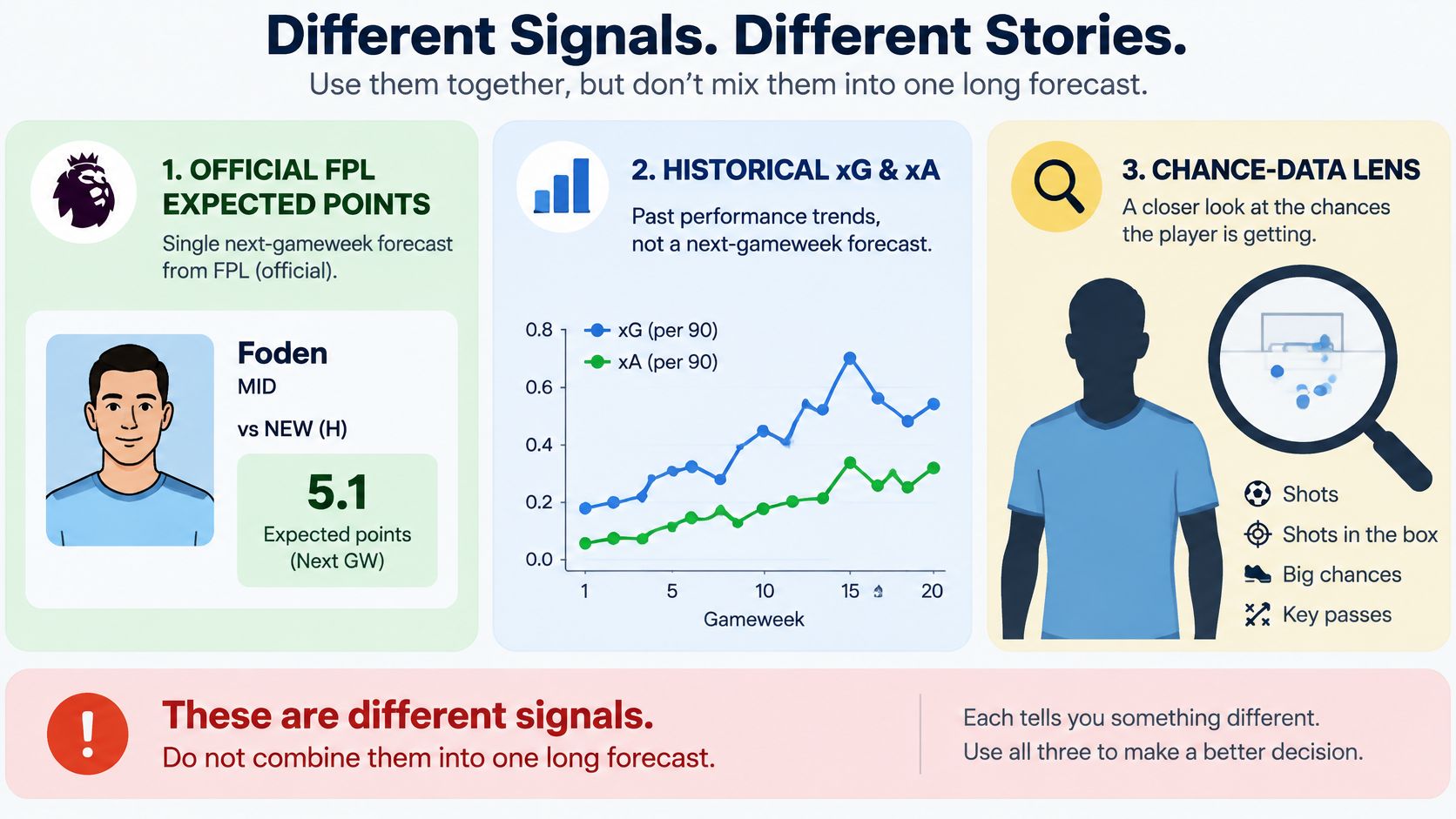
Player prices, points, ownership, form, transfers and expected statistics come from the official Fantasy Premier League data. TFA projections are estimates, not official FPL forecasts. The predicted points guide covers how to read a one-week projection beside chance data within a single Gameweek.
When the signals conflict
High official xP, uncertain minutes. Bench or hold rather than start. The projection does not create a role.
Modest xP, secure starter, strong chance involvement. Start, and state the window behind the xG, xA and xGI figures.
Set pieces and current availability. Check these after the minutes check, because a penalty or a corner only counts if the player is on the pitch.
A realistic alternative. Weigh the secure minutes already in the squad before chasing the larger one-week number.
Run the checks in sequence:
Minutes probability.
The upcoming Gameweek projection.
Chance involvement over a stated window.
Set-piece duties and current availability.
The practical alternative already in the squad.
Position, price, minutes and availability filters can remove players who do not fit the squad decision before that evidence is even weighed. Historical xG, xA and xGI per 90 describe what happened inside a stated window. They still need the role, and the minutes, to repeat.
Buying, Holding and Benching Owned Players
Bench the player whose minutes are in doubt, hold the one whose role is intact, and buy only when the newcomer beats the best owned alternative at the same price after any transfer cost. One soft fixture, or one recent haul, does not change a role.
FPL asks you to choose 11 players from a 15-player squad to score each Gameweek, with four on the bench. Official guidance lists minutes, goals, assists, clean sheets, saves, defensive contributions and bonus points as routes to scoring, so every start needs both involvement and time on the pitch. Captaincy applies the same minutes-first logic already set for the starting XI, weighted by the multiplied return. A high-upside attacker with a secure role can be preferred to a similarly priced player whose starts are uncertain, while a defensive captain needs confidence in both selection and clean-sheet conditions. Take a hypothetical mid-priced midfielder on penalties who starts every week at modest ownership: he can outscore the most-bought forward in the game over a Gameweek, because price and ownership measure popularity rather than minutes. Official expected points cover one Gameweek, and any comparison should state its season, Gameweek window and data-capture date while keeping completed-match statistics apart from live or market data.
Moving a high-priced player out to fund a purchase raises the stakes, because you sell a role as well as a price. The captain must come from the starting XI, so a benched player is out of that conversation entirely. Before paying for a replacement, position, price, minutes and availability filters can strip a shortlist down to players who fit the gap in your squad.
Conditional verdicts for owned players and purchases
Situation | Owned player | Potential purchase |
|---|---|---|
Secure starter, favourable next fixture | Hold and start | Buy only if it beats the best owned option at the same price |
Rotation risk with high attacking numbers | Bench until minutes are confirmed | Do not buy on attacking numbers alone |
Doubtful availability before the deadline | Bench and reassess with team news | Wait for a confirmed role before buying |
Budget-constrained extra transfer | Keep if the expected gain is smaller than the 4-point hit | Buy only if the expected gain covers the hit |
Captaincy choice | Start and captain if minutes are confirmed | Captain only a starter with secure minutes |
I would not sell a secure starter to chase a single soft fixture. I would bench a rotation risk until the role is confirmed, and I would leave a doubtful player out of the XI until team news arrives before the cutoff. A purchase is justified by role and confirmed minutes. If the expected gain from an extra transfer is smaller than the points hit, keep the player you have.
Buy the role you can defend for 60 minutes. Hold the one you already can.
Confirm the Lineup Before the Deadline
Take a hypothetical deadline morning: the cutoff is 90 minutes away and a rumour says your second striker may be benched. The start-or-bench call was already built on minutes and next-Gameweek expected points. The remaining job is to confirm that work against real team news, then lock it in.
Set the frame. Note the target Gameweek, the cutoff time and the date each figure was captured.
Read official team news. Check each starter against club reporting before the cutoff, and treat a chance-of-playing flag as unresolved until that reporting lands.
Check bench coverage. Order the bench so the first substitute covers the likeliest no-show and the formation still works if a starter misses out.
Save and verify. Submit the team before the deadline and confirm the saved XI on the confirmation screen.
Free player profiles, plus Differential Picks, Budget Picks and Form Plus Next Fixture, are open without a paid login on the FPL Player Stats homepage.
Start the player whose minutes are most secure, and bench any option whose role is still in doubt.
Open the two names you are still torn between, write the likely minutes beside each one, and only then read the fixture. If the minutes are not secure, leave that player on the bench for this Gameweek and move the armband to the starter you can see playing.